You may recall that I love Raclette. I think it blows fondue out of the milk! You don't have to worry about hot splash back or losing your chunk in hot lava cheese. Fondue also has limited creativity and combinations. The basic principal is skewer chunk (meat, veggie, fruit, bread) and dip in cheese, oil, or chocolate. It is hard to factor much else into the equation.
Raclette is full of possibilities. You take some Raclette cheese and add anything to it and keep adding different ingredients. You just don't want to pile on so much that the food will be touching the heating element because it will either burn or catch on fire. One trick to Raclette is to forget about it, then you will achieve that golden crunchy cheese yumminess.
I think of Raclette as a winter activity and was very happy to get a cold spell this weekend. We hadn't used our Raclette grill since last winter and I wanted to use it before next winter. We planned a small gathering of about 8 people total. You don't want too many people running around with hot cheese when you have 2 dogs and a baby underfoot. It was fun for everybody to come up different combinations and share "recipes".
The cheeses we had were Raclette as well as Beemster goat Gouda (which is a nice melter) and Robiola Bosina (not a good melter as the fat content is too high). The meats were a goose liver pate, Landjaeger which is a dried hunters sausage, Porchetta which is pork loin wrapped in pancetta, and Finnochionia. There was also crispy kale, olives, marinated mushrooms, portabello mushrooms, cornishons, melba toast, baguette, and of course boiled potatoes. I also offered a selection of salts, smoked Maldon, green herb salt, and a red spice salt.
The standout highlight combination of the night was Raclette with marinated mushrooms and crispy kale. I can't stop thinking of it even though I ate a ton that night. I am gonna put that combination into a grilled cheese. I could even do an open face grilled cheese under the broiler! What a great way to get in your greens.
Showing posts with label cheese. Show all posts
Showing posts with label cheese. Show all posts
Tuesday, March 6, 2012


Friday, February 11, 2011
Raw Milk Review
The debate over raw milk and cheeses made from raw milk has been heating up this winter. This past December, Sally Jackson Cheese recalled all of their cheeses due to the possibility of E. coli 0157:H7 contamination. This causes diarrhea and bloody stools with most healthy adults recovering within a week. It is possible to develop Hemolytic Uremic Syndrome which is a form of kidney failure. The elderly and young children are more likely to develop this condition which can lead to kidney damage and death.
So what went wrong? Sally Jackson makes cheese from raw or unpasteurized, cow, goat, and sheep milk. These cheeses were found to be made under conditions that create a risk of contamination when the facility was inspected by health officials. The cheeses were identified as one possible source of E. coli infection. There were 8 reported cases between September and November of E. coli in Washington and Oregon which could be traced to Sally Jackson cheeses.
Seven patients were able to provide food histories and one reported eating Sally Jackson cheese. Four patients said they may have eaten Sally Jackson cheese, three of these ate at restaurants which served Sally Jackson cheese. The 4th of these ate a variety of artisinal cheeses which may have included Sally Jackson cheese. Two patients had consumed artisanal cheese but were unsure if any of it was made by Sally Jackson.
Sally Jackson began making cheese after receiving a "Small and Appropriate Technology Grant” during the Carter administration. They tended 140 acres in Oroville, WA and raised goats, sheep, and a few cows. They made cheese exclusively from the milk of their own herds. All cheeses were made from raw milk and aged for 60 days as per FDA regulations. I was able to try one of their cheeses at a Slow Food event in which Cowgirl Creamery provided a handsome cheese plate. I remember being very excited to finally get to taste some of the well know Sally Jackson cheese. I was impressed by its clean taste and supple paste.
Sally Jackson closed its doors in December. Their website, http://www.sallyjacksoncheeses.com has a very brief statement which does not go into detail but says that, "Many factors went into our decision to retire the business." Among these must have been heartbreak and frustration. The possibility of even one person getting sick from a cheese I made is a risk I do not want to take. I do not know the conditions of their cheesemaking operation but having a government agency come in and declare it unsanitary must have been very painful.
Bravo Farms in Traver, CA also had an outbreak of E. coli in which 38 people in 5 states became sick. This outbreak was traced to their raw milk Gouda which was sold by retail giant Costco. Investigators cite Bravo Farms with packaging their cheese for sale before the 60 day aging period ended. In the case of Sally Jackson, the facility was found to be unsanitary.
In both cases, investigators are unable to clearly state that the contamination has been traced to the raw milk used to in making the cheese. Contamination can occur at any part of the cheesemaking process regardless of whether the milk is raw or pasteurized. The issue these cases has brought to the forefront is the effectiveness of the 60 day aging rule. It has been widely accepted that cheese made from raw milk and aged 60 days will naturally destroy any harmful bacterial during that period. The bacteria, acid, and salt in cheese will consume any harmful bacteria within that 60 day time frame. But it is not just raw milk cheesemakers getting recalled. In 2009, nine cheesemakers in the US issued recalls and five used pasteurized milk and the other four made raw milk cheeses.
What we are learning now is that the 60 day time frame was an arbitrary decision. This rule was created in the 1940's after outbreaks of typhoid fever were linked to cheese. Scientists knew that as a cheese dried out it was no longer an ideal environment for bacteria. This lead to the 60 day rule which is now being seen as simplistic. Cheese has changed a lot since the 1940's and they are many different types of cheese currently being made in the US. The pathogens in cheese have also changed, making E. coli and listeria more dangerous threats.
Recently a paper was published which showed that E. coli could survive in cheese for more than a year. A study from 2008 showed that levels of listeria increase in soft cheese as it aged. This style of cheese becomes less acidic as it ages and moisture increases which are good conditions for bacteria. So what can we do to ensure that cheese is safe?
Food safety has become a major issue with recent outbreaks in spinach, celery, and eggs. The Food Safety Modernization Act was passed by the U.S. Senate December 22, 2010 and President Obama signed it into law on January 4th 2011. This bill aims to prevent food borne illness outbreaks before they occur. Some provisions of this bill include:
*Enables the FDA to issue a food recall. Previously, the company had to issue a voluntary food recall.
*Evey two years, the FDA will identify major threats to food safety and provide science based outlines and regulations to deal with these threats.
*Create offices in at least 5 forgien countries that export food to the US to improve food oversight.
*The FDA will inspect high risk food production facilities every three years.
I didn't see any mention of raw milk or raw milk cheese in the information given about the Food Safety Modernization Act. This legislation seems to focus on produce and imported food. But it is agreed that the cheese industry does need to improve food safety standards which go beyond aging. Raw milk should be tested frequently as well as the finished product throughout various stages of aging. It is also necessary to improve hygiene and stress its importance.
The raw milk I get from my local farm is tested daily and the results are posted. I have never been concerned about their milk and have every confidence in their cleanliness. I was surprised when a dairy farmer told me about an exchange she had with a neighbor farmer. The neighbor was shocked that they dairy farmer consumed raw goat milk. The neighbor thought it was too dangerous of a substance for family consumption. But when you are so involved in every step of the process from raising the goats, feeding them, breeding them, and milking them, why not drink the raw milk? There is nothing inherent in raw milk which makes it dangerous.
Milk and cheese must be tested and these regulations vary from state to state. Do we need to make these regulations uniform as the end product does cross state lines? Cheesemakers should not fear testing and inspection as this will ensure food safety which is good for the cheesemaker and consumer. It can be difficult dealing with new regulations when you are so accustomed to doing things the way they have always been done in your operation. Changes can also be costly which is very difficult to afford in this economic climate. I would hate to see more wonderful cheesemakers go out of business.
I was at a conference recently (more on this in a later blog) and was surprised when a lecturer said that there is no good and bad bacteria, just bacteria. She was teaching us about pH and TA testing. Preforming these tests throughout the cheesemaking process will ensure a safe end product. This is a practice I have yet to apply to my cheesemaking, but now that I have learned of its importance I will put it into practice.
I do not know the future of raw milk cheeses but I do not think we need to outlaw all raw milk cheeses. If you were to do that, you may as well outlaw all cheese. Raw milk cheese in various stages have been consumed in France for ages but even the European Union is starting to crack down on raw milk and cheese made from raw milk. It would be a shame to lose the traditions of raw milk cheese. You could kiss your Parmigiano-Reggiano and your Roquefort good bye!
So what went wrong? Sally Jackson makes cheese from raw or unpasteurized, cow, goat, and sheep milk. These cheeses were found to be made under conditions that create a risk of contamination when the facility was inspected by health officials. The cheeses were identified as one possible source of E. coli infection. There were 8 reported cases between September and November of E. coli in Washington and Oregon which could be traced to Sally Jackson cheeses.
Seven patients were able to provide food histories and one reported eating Sally Jackson cheese. Four patients said they may have eaten Sally Jackson cheese, three of these ate at restaurants which served Sally Jackson cheese. The 4th of these ate a variety of artisinal cheeses which may have included Sally Jackson cheese. Two patients had consumed artisanal cheese but were unsure if any of it was made by Sally Jackson.
Sally Jackson began making cheese after receiving a "Small and Appropriate Technology Grant” during the Carter administration. They tended 140 acres in Oroville, WA and raised goats, sheep, and a few cows. They made cheese exclusively from the milk of their own herds. All cheeses were made from raw milk and aged for 60 days as per FDA regulations. I was able to try one of their cheeses at a Slow Food event in which Cowgirl Creamery provided a handsome cheese plate. I remember being very excited to finally get to taste some of the well know Sally Jackson cheese. I was impressed by its clean taste and supple paste.
Sally Jackson closed its doors in December. Their website, http://www.sallyjacksoncheeses.com has a very brief statement which does not go into detail but says that, "Many factors went into our decision to retire the business." Among these must have been heartbreak and frustration. The possibility of even one person getting sick from a cheese I made is a risk I do not want to take. I do not know the conditions of their cheesemaking operation but having a government agency come in and declare it unsanitary must have been very painful.
Bravo Farms in Traver, CA also had an outbreak of E. coli in which 38 people in 5 states became sick. This outbreak was traced to their raw milk Gouda which was sold by retail giant Costco. Investigators cite Bravo Farms with packaging their cheese for sale before the 60 day aging period ended. In the case of Sally Jackson, the facility was found to be unsanitary.
In both cases, investigators are unable to clearly state that the contamination has been traced to the raw milk used to in making the cheese. Contamination can occur at any part of the cheesemaking process regardless of whether the milk is raw or pasteurized. The issue these cases has brought to the forefront is the effectiveness of the 60 day aging rule. It has been widely accepted that cheese made from raw milk and aged 60 days will naturally destroy any harmful bacterial during that period. The bacteria, acid, and salt in cheese will consume any harmful bacteria within that 60 day time frame. But it is not just raw milk cheesemakers getting recalled. In 2009, nine cheesemakers in the US issued recalls and five used pasteurized milk and the other four made raw milk cheeses.
What we are learning now is that the 60 day time frame was an arbitrary decision. This rule was created in the 1940's after outbreaks of typhoid fever were linked to cheese. Scientists knew that as a cheese dried out it was no longer an ideal environment for bacteria. This lead to the 60 day rule which is now being seen as simplistic. Cheese has changed a lot since the 1940's and they are many different types of cheese currently being made in the US. The pathogens in cheese have also changed, making E. coli and listeria more dangerous threats.
Recently a paper was published which showed that E. coli could survive in cheese for more than a year. A study from 2008 showed that levels of listeria increase in soft cheese as it aged. This style of cheese becomes less acidic as it ages and moisture increases which are good conditions for bacteria. So what can we do to ensure that cheese is safe?
Food safety has become a major issue with recent outbreaks in spinach, celery, and eggs. The Food Safety Modernization Act was passed by the U.S. Senate December 22, 2010 and President Obama signed it into law on January 4th 2011. This bill aims to prevent food borne illness outbreaks before they occur. Some provisions of this bill include:
*Enables the FDA to issue a food recall. Previously, the company had to issue a voluntary food recall.
*Evey two years, the FDA will identify major threats to food safety and provide science based outlines and regulations to deal with these threats.
*Create offices in at least 5 forgien countries that export food to the US to improve food oversight.
*The FDA will inspect high risk food production facilities every three years.
I didn't see any mention of raw milk or raw milk cheese in the information given about the Food Safety Modernization Act. This legislation seems to focus on produce and imported food. But it is agreed that the cheese industry does need to improve food safety standards which go beyond aging. Raw milk should be tested frequently as well as the finished product throughout various stages of aging. It is also necessary to improve hygiene and stress its importance.
The raw milk I get from my local farm is tested daily and the results are posted. I have never been concerned about their milk and have every confidence in their cleanliness. I was surprised when a dairy farmer told me about an exchange she had with a neighbor farmer. The neighbor was shocked that they dairy farmer consumed raw goat milk. The neighbor thought it was too dangerous of a substance for family consumption. But when you are so involved in every step of the process from raising the goats, feeding them, breeding them, and milking them, why not drink the raw milk? There is nothing inherent in raw milk which makes it dangerous.
Milk and cheese must be tested and these regulations vary from state to state. Do we need to make these regulations uniform as the end product does cross state lines? Cheesemakers should not fear testing and inspection as this will ensure food safety which is good for the cheesemaker and consumer. It can be difficult dealing with new regulations when you are so accustomed to doing things the way they have always been done in your operation. Changes can also be costly which is very difficult to afford in this economic climate. I would hate to see more wonderful cheesemakers go out of business.
I was at a conference recently (more on this in a later blog) and was surprised when a lecturer said that there is no good and bad bacteria, just bacteria. She was teaching us about pH and TA testing. Preforming these tests throughout the cheesemaking process will ensure a safe end product. This is a practice I have yet to apply to my cheesemaking, but now that I have learned of its importance I will put it into practice.
I do not know the future of raw milk cheeses but I do not think we need to outlaw all raw milk cheeses. If you were to do that, you may as well outlaw all cheese. Raw milk cheese in various stages have been consumed in France for ages but even the European Union is starting to crack down on raw milk and cheese made from raw milk. It would be a shame to lose the traditions of raw milk cheese. You could kiss your Parmigiano-Reggiano and your Roquefort good bye!
Tuesday, February 1, 2011
Rind time!
To eat the rind or not to eat the rind, that is the question. A woman was very perplexed recently when I offered her a taste of Bonne Bouche; she said "it's blue!” She was lacking confidence in her knowledge of cheese rinds and in her cheesemonger. Bonne Bouche is an ash ripened goat cheese that has a grayish blue rind that is completely edible. The rind is coated with vegetable ash which is often used in cheesemaking. Humboldt Fog and Morbier are two classic examples of cheeses that use ash. Both have a line of ash through the center of the paste.
Many that night were calling Bonne Bouche a blue cheese but it's not, it just has a striking look which makes it a great addition to any cheese plate. I love Bonne Bouche, the ash coating helps the cheese age, prevents unwanted molds and intruders, and helps the paste get crazy runny and gooey. This cheese won best goat cheese at the 2010 American Cheese Society conference. You can learn more about Bonne Bouche at http://www.vermontcreamery.com/bonne-bouche/
Some cheeses have a natural rind like bandaged wrapped cheddar. This means that the truckle (term for a wheel of cheddar which refers to its shape) was wrapped in cheesecloth which is often coated in lard and then aged. Before the cheese goes to market the cheesecloth is removed but you can still see the hatch marks on the rind left behind from the texture of the cloth. You can choose to eat this rind if you like but it will be a bit dry. Similarly, other cheeses get a paper coating to their rind. If won’t kill you to eat paper but it won’t add much flavor.
Blue cheeses like Cashel blue and Mountain Gorgonzola have a natural rind. The rind on Mountain Gorgonzola can be dry and brittle. Often the natural rind on a blue cheese can be more concentrated in flavor. You can decide to eat them if you want. Some blue cheeses like Buttermilk Blue and Maytag blue have no rinds. Their rinds are removed before packaging.
There are a few rinds that you really don't want to eat. If a cheese is covered in wax, don't eat it unless you are nostalgic for the wax lips of your childhood. It won't kill you to eat wax but it also will not taste very good. Some chesses have a thick wax coating and others like Manchego or P’tit Basque have a very thin waxy coating. You can cut off these rinds and enjoy your cheese. When serving this type of cheese on a party platter, it is best to cut the wax off the sides of the wedge but leave the wax along the back as it will provide a bit of support while guests cut off chunks.
If a cheese has a wooden belt like Petit Sapin or Winnimere, do not eat the wood. These types of cheeses are best served in the whole with the top rind peeled back and the glorious goo spooned out. But a wedge of Winnimere can also be delicious but as it is a washed rind cheese, the rind will have a more concentrated flavor. The rind is exposed to multiple washings in a brine solution which may contain some kind of alcohol. The salt and flavor will concentrate on the rind with a specific type of red mold called Bacteria Linens. This type of mold is intentional and gives washed rind cheeses their stinky nature. When you see mold whether it is red, white, or blue ask yourself if it was intentional and if it was give it a taste.
Things can get confusing when a cheese is covered in leaves. Valdeon is a wonderful Spanish blue cheese made from goat’s and cow’s milk with a covering of Sycamore leaves. These leaves make a pretty presentation but are not edible. Once again, this will not kill you but won’t help the flavor. Rogue River Blue is a raw cow’s milk blue made in Oregon that is covered in grape leaves soaked in pear brandy. These leaves are edible and offer a unique flavor and texture to the cheese. If the leaves are dry, I would avoid them but it they have been drenched in some kind of alcohol, I may taste them and then decide if they are worth eating.
Really when it comes down to the rind it is a matter of taste preference. Try the rind first and if you don’t like the taste don’t eat it. But please take the rind with you, I hate seeing a sad slice of brie being hollowed out at a party. It is unattractive and leads others to think that the rind is not edible when they might enjoy the taste. It’s like asking someone else to clean up your mess.
The rind on Soft Ripened cheeses like Brie, Camembert, and Humboldt Fog are edible and made from a white mold which is often penicillium candidum and/or geotrichum candidum. Some inexpensive bries and camembert have a rind that is papery and a paste that is firm. That is not what I look for in brie so I skip them. I love d’Affinois which has a very mild rind which lends body to the very creamy paste. But the rind on a soft ripened cheese can become bitter with age. When that is the case, I may choose to discard the rind. Pierre Robert is an indulgent triple crème from France but I often find the rind too bitter and will scoop out the runny paste.
If a cheese has mold that was not intended and has developed with time you might not have to trash the whole chunk. If you have a chunk of cheddar that has gone a bit moldy, cut off the mold until the paste is pure and enjoy. Do not eat a cheese that has cat fur mold, unintended red mold, or smells like urine. If the cheese is a soft, fresh cheese, or a surface ripened cheese, you might have to let it go as it can be hard to remove unwanted molds from these creamy cheeses.
I hope this provides some rind confidence and remember what doesn’t kill you only makes you stronger! And a tip, Parmigiano-Reggiano rinds aren't edible but they can be added to soups, stocks, and stews to add a wonderful salty, cheese flavor.
Many that night were calling Bonne Bouche a blue cheese but it's not, it just has a striking look which makes it a great addition to any cheese plate. I love Bonne Bouche, the ash coating helps the cheese age, prevents unwanted molds and intruders, and helps the paste get crazy runny and gooey. This cheese won best goat cheese at the 2010 American Cheese Society conference. You can learn more about Bonne Bouche at http://www.vermontcreamery.com/bonne-bouche/
Some cheeses have a natural rind like bandaged wrapped cheddar. This means that the truckle (term for a wheel of cheddar which refers to its shape) was wrapped in cheesecloth which is often coated in lard and then aged. Before the cheese goes to market the cheesecloth is removed but you can still see the hatch marks on the rind left behind from the texture of the cloth. You can choose to eat this rind if you like but it will be a bit dry. Similarly, other cheeses get a paper coating to their rind. If won’t kill you to eat paper but it won’t add much flavor.
Blue cheeses like Cashel blue and Mountain Gorgonzola have a natural rind. The rind on Mountain Gorgonzola can be dry and brittle. Often the natural rind on a blue cheese can be more concentrated in flavor. You can decide to eat them if you want. Some blue cheeses like Buttermilk Blue and Maytag blue have no rinds. Their rinds are removed before packaging.
There are a few rinds that you really don't want to eat. If a cheese is covered in wax, don't eat it unless you are nostalgic for the wax lips of your childhood. It won't kill you to eat wax but it also will not taste very good. Some chesses have a thick wax coating and others like Manchego or P’tit Basque have a very thin waxy coating. You can cut off these rinds and enjoy your cheese. When serving this type of cheese on a party platter, it is best to cut the wax off the sides of the wedge but leave the wax along the back as it will provide a bit of support while guests cut off chunks.
If a cheese has a wooden belt like Petit Sapin or Winnimere, do not eat the wood. These types of cheeses are best served in the whole with the top rind peeled back and the glorious goo spooned out. But a wedge of Winnimere can also be delicious but as it is a washed rind cheese, the rind will have a more concentrated flavor. The rind is exposed to multiple washings in a brine solution which may contain some kind of alcohol. The salt and flavor will concentrate on the rind with a specific type of red mold called Bacteria Linens. This type of mold is intentional and gives washed rind cheeses their stinky nature. When you see mold whether it is red, white, or blue ask yourself if it was intentional and if it was give it a taste.
Things can get confusing when a cheese is covered in leaves. Valdeon is a wonderful Spanish blue cheese made from goat’s and cow’s milk with a covering of Sycamore leaves. These leaves make a pretty presentation but are not edible. Once again, this will not kill you but won’t help the flavor. Rogue River Blue is a raw cow’s milk blue made in Oregon that is covered in grape leaves soaked in pear brandy. These leaves are edible and offer a unique flavor and texture to the cheese. If the leaves are dry, I would avoid them but it they have been drenched in some kind of alcohol, I may taste them and then decide if they are worth eating.
Really when it comes down to the rind it is a matter of taste preference. Try the rind first and if you don’t like the taste don’t eat it. But please take the rind with you, I hate seeing a sad slice of brie being hollowed out at a party. It is unattractive and leads others to think that the rind is not edible when they might enjoy the taste. It’s like asking someone else to clean up your mess.
The rind on Soft Ripened cheeses like Brie, Camembert, and Humboldt Fog are edible and made from a white mold which is often penicillium candidum and/or geotrichum candidum. Some inexpensive bries and camembert have a rind that is papery and a paste that is firm. That is not what I look for in brie so I skip them. I love d’Affinois which has a very mild rind which lends body to the very creamy paste. But the rind on a soft ripened cheese can become bitter with age. When that is the case, I may choose to discard the rind. Pierre Robert is an indulgent triple crème from France but I often find the rind too bitter and will scoop out the runny paste.
If a cheese has mold that was not intended and has developed with time you might not have to trash the whole chunk. If you have a chunk of cheddar that has gone a bit moldy, cut off the mold until the paste is pure and enjoy. Do not eat a cheese that has cat fur mold, unintended red mold, or smells like urine. If the cheese is a soft, fresh cheese, or a surface ripened cheese, you might have to let it go as it can be hard to remove unwanted molds from these creamy cheeses.
I hope this provides some rind confidence and remember what doesn’t kill you only makes you stronger! And a tip, Parmigiano-Reggiano rinds aren't edible but they can be added to soups, stocks, and stews to add a wonderful salty, cheese flavor.
Wednesday, January 12, 2011
Cheesemonger for the masses!
Epoisses, Brebirousse, d'Affinois, Gres des Vosges, Rogue River Blue, Roquefort, Valdeon, Coupole, Bonne Bouche, Humboldt Fog, P'tit Basque, Ossau Iraty, Beecher's Flagship Cheddar, 5 year aged Gouda, Midnight Moon, Lamb Chopper, Taleggio, Fontina Val D'aosta, Burrata. These are all wonderful cheese which are now available at Safeway. Yes that is right, welcome to the World of Cheese at Safeway! The super gigantic supermarket chain is selling high end cheese and charcuterie. But not just any Safeway, the only cheese counter of its kind is at the Georgetown Safeway in DC. Safeway is using this store as a barometer of how a high end cheese counter might do in other store locations. They have even taken a few of our top selling cheese to the store location in Potomac.

How do I know this? Because I started working for Safeway at the end of May 2010 and am currently still mongering there 15 hours a week. It has been an interesting experience for me to be involved in such a new corporate endeavour. I have worked at a few different cheese counters in Northern Virginia and all of them, till now, had been independently owned. When I first got the job, it was hard for me to say that I worked at Safeway and often told people that I worked at a cheese counter in Georgetown. But now, I am proud of my job at Safeway and the vast array of cheeses we offer.

It has been said that our cheese selection is the largest in DC and that our French selection is the largest in the area. I have not gone out to pound the pavement to verify these claims but I do feel comfortable saying that we have the largest and most diverse selection of cheeses than any other supermarket in DC. We definitely have more cheese than the average Whole Foods but Wegman's does rival our selection. Wegman's also cuts most of their cheeses in the store, something I wish we did at the World of Cheese.
At the Georgetown Safeway, we do not cut every cheese we offer. We do cut most of our soft ripened cheeses and blue cheeses. We have to cut d'Affinois, Saint Andre, and Supreme every day as they are among our top selling cheeses. We also cut P'tit Basque, Ossau Iraty, Tallegio, and many other cheeses. We do not cut any of our vast selection of Cheddars in the store. Cheeses we do not cut are either cut at our distribution center in Maryland or are packaged by the cheesemaker. I do believe that the best cheese is cut fresh off a whole wheel but packaged cheese is still pretty good. Still better than processed Kraft singles or Velveeta.
We also do not cut the Parmigiano-Reggiano in the store. This is cut at our distribution center and we receive it frequently throughout the week. But it is this one cheese that gets the most criticism from our customers. People look at it and do not believe it is real Italian Parmigiano-Reggiano. They say it is too hard or that they are Italian and have never heard of Bella Rossa. There is often no convincing the customer otherwise. Let me take this opportunity to explain why are Parm is the real deal.
Bella Rossa is made in Italy, aged 24 months, and distributed by Arthur Schuman, an American company. For any cheese to be legally called Parmigiano-Reggiano it must meet DOC (Denominazione Di Origine Controllata) regulations. Therefore it must be made in Italy, in either Emilia Romagna or Lombardy. It must be made from partially skimmed cow's milk and the cow's have strict dietary rules and cannot be feed any silage. Once the wheels are made and aged they undergo a strict DOC inspection process. If the wheels pass inspection, the rind is stamped with the Parmigiano-Reggiano Consortium mark. If you ever question the authenticity of a Parmigiano-Reggiano, look at the rind. If you can see the name stenciled into the rind, it is the real thing. What we sell at Safeway is the real thing but it would be better and fresher if we cut it in the store.

So why is it that we do not cut all the cheeses in store? Our store is open 24 hours, seven days a week and sells a whole lot of cheese with only 3 dedicated World of Cheese employees and one manager. Sometimes it is hard enough for us to stay on top of all the cutting, stocking, cleaning, and other cheese counter chores. We make Baked Bries in store and shred and grate various types of cheese as well as fill orders for our catering department. We also have a severe lack of space. It can get very crowded behind our counter and I hate cutting cheese with my back to customers but you do what you gotta. One thing I do really like about the cheese counter at Wegman's is they have a spacious work area in the center of their cheese counters.
We are also working to expand our cheese selection. This could not be done without our fromagerie manager, Treva Stose. She has put in countless hours fighting for wonderful cheeses to make it into the World of Cheese. Even when she is not working, she is working. She is very dedicated to the World of Cheese at Safeway and has worked tirelessly for it to be the best cheese counter in DC. She takes great care with our French air freight cheeses and is now working on expanding our Italian and Spanish cheese selection.

When the World of Cheese first opened in May 2010, we had to order all of our cheeses, Pates, and salamis through one distribution company, DPI. We had a few difficulties and Treva fought corporate to be allowed to use another distributor. If DPI did not have the cheese, we could not sell the cheese. Cheeses Safeway used to sell disappeared and some of the cheeses we did receive were not in the best condition or cut in a manner that was not ideal. We do not accept anything less than the best and any issues we take to our most wonderful DPI rep, John. Such a demanding high end cheese counter is pretty new for our distributor and the start of any new process will have some growing pains.
Recently, we have begun using Epicure and hope to order more exciting new cheeses through them. Any cheese we order from them, we will have to cut in the store. But getting new cheeses is a bit of a struggle. At cheese counters where I have worked previously, I would only have to make a case for that cheese with the store manager and then they would order it through one of their distributors. As Safeway is a large national retail chain, all items must be approved by our corporate office in California. Since the store opened in May, customers have been asking for Mozzarella DI' Bufala. Customers ask us, we tell our Manager, and she takes it to our distributor and corporate. We still do not have Mozzarella Di' Bufala but have been told that it is in the works. We take our customer requests very seriously and make notes whenever a customer asks for a specific cheese. No matter how often a cheese is requested, it does not guarantee a spot for that cheese in our case. And if a cheese doesn't sell, like Limburger, chances are that it will disappear from our counter.

Halloumi is a wonderful cheese, I love to grill it in the summertime. One of the first Saturday cheese demos I did at the store was grilled Halloumi. Everyone loved the cheese and was excited about its cooking possibilities. When I went to check the sales figures the next day, I found that it wasn't on the report. The cheese did not have a scanable barcode and was not an approved item. We fought to get this item approved by corporate but it continues to be denied even though it sold well and was requested by many customers. But we do not stop trying and sometimes unauthorized items magically appear in our counter.

One thing I love about working at the "Social" Safeway in Georgetown is the diversity of our customers. We get all types from every walk of life and I love hearing all the different languages being spoken all around the store. Every day we lure these people to our cheese counter with samples of different cheeses. I love giving a person a new cheese to taste and when that person really loves what they are tasting. We have had young children go gaga over Epoisses, which is one of our top selling cheeses.
We love to take the time to educate our customers regarding cheese. We love to take time to help them assemble their cheese platters, or pick cheeses for a fancy grilled cheese or mac and cheese. We also offer a lot of wine pairing advice as we are located right next to the wine department. If they are tasting wine or beer in that department, you can be sure they are serving a carefully selected cheese to go with that tasty beverage. Customer service, interaction, and satisfaction are very high priorities at Safeway. I love any opportunity to talk cheese!

Some customers get frustrated because all of our cheeses are not located all in one place. Our store is very big, 71067 square feet, and can take a long time to navigate. People often ask where the "regular" cheese is located. Not sure what "regular" means because what is regular for me, like chevre, might not be regular for someone else. But what they are usually looking for is located in aisle 3, which is also the cracker aisle. This is where the cream cheese, Velveeta, packaged processes cheese, shredded cheese, and some kosher cheeses are located. But to further confuse, we also have cheese located on the other side of the wine department along the back wall. This is where you will find your port wine cheese, Boursin, in-store grated cheese, crumbled cheese, and sliced cheese as well as summer sausage and hummus. I like to call this wall our shreds and spreads section but it is a lot more than that. We have such a variety of cheese, that to keep it all in one place would be a very overwhelming space. At the World of Cheese, we have close to 200 different kinds of cheese on any given day.
I think offering such a wide variety of cheeses in a supermarket is a wonderful thing. It makes cheese more accessible to all and might demystify cheese for some people. I have seen people get very intimidated by cheese which can cause them to get frustrated and overwhelmed. It is only food and the cheese can stand alone, it is really hard to pick the "wrong" cheese. In this type of environment where you are free to walk up and grab whatever you like without asking may empower people to explore new cheese horizons without fear. And if you have any questions, we are here!

How do I know this? Because I started working for Safeway at the end of May 2010 and am currently still mongering there 15 hours a week. It has been an interesting experience for me to be involved in such a new corporate endeavour. I have worked at a few different cheese counters in Northern Virginia and all of them, till now, had been independently owned. When I first got the job, it was hard for me to say that I worked at Safeway and often told people that I worked at a cheese counter in Georgetown. But now, I am proud of my job at Safeway and the vast array of cheeses we offer.

It has been said that our cheese selection is the largest in DC and that our French selection is the largest in the area. I have not gone out to pound the pavement to verify these claims but I do feel comfortable saying that we have the largest and most diverse selection of cheeses than any other supermarket in DC. We definitely have more cheese than the average Whole Foods but Wegman's does rival our selection. Wegman's also cuts most of their cheeses in the store, something I wish we did at the World of Cheese.
At the Georgetown Safeway, we do not cut every cheese we offer. We do cut most of our soft ripened cheeses and blue cheeses. We have to cut d'Affinois, Saint Andre, and Supreme every day as they are among our top selling cheeses. We also cut P'tit Basque, Ossau Iraty, Tallegio, and many other cheeses. We do not cut any of our vast selection of Cheddars in the store. Cheeses we do not cut are either cut at our distribution center in Maryland or are packaged by the cheesemaker. I do believe that the best cheese is cut fresh off a whole wheel but packaged cheese is still pretty good. Still better than processed Kraft singles or Velveeta.
We also do not cut the Parmigiano-Reggiano in the store. This is cut at our distribution center and we receive it frequently throughout the week. But it is this one cheese that gets the most criticism from our customers. People look at it and do not believe it is real Italian Parmigiano-Reggiano. They say it is too hard or that they are Italian and have never heard of Bella Rossa. There is often no convincing the customer otherwise. Let me take this opportunity to explain why are Parm is the real deal.
Bella Rossa is made in Italy, aged 24 months, and distributed by Arthur Schuman, an American company. For any cheese to be legally called Parmigiano-Reggiano it must meet DOC (Denominazione Di Origine Controllata) regulations. Therefore it must be made in Italy, in either Emilia Romagna or Lombardy. It must be made from partially skimmed cow's milk and the cow's have strict dietary rules and cannot be feed any silage. Once the wheels are made and aged they undergo a strict DOC inspection process. If the wheels pass inspection, the rind is stamped with the Parmigiano-Reggiano Consortium mark. If you ever question the authenticity of a Parmigiano-Reggiano, look at the rind. If you can see the name stenciled into the rind, it is the real thing. What we sell at Safeway is the real thing but it would be better and fresher if we cut it in the store.

So why is it that we do not cut all the cheeses in store? Our store is open 24 hours, seven days a week and sells a whole lot of cheese with only 3 dedicated World of Cheese employees and one manager. Sometimes it is hard enough for us to stay on top of all the cutting, stocking, cleaning, and other cheese counter chores. We make Baked Bries in store and shred and grate various types of cheese as well as fill orders for our catering department. We also have a severe lack of space. It can get very crowded behind our counter and I hate cutting cheese with my back to customers but you do what you gotta. One thing I do really like about the cheese counter at Wegman's is they have a spacious work area in the center of their cheese counters.
We are also working to expand our cheese selection. This could not be done without our fromagerie manager, Treva Stose. She has put in countless hours fighting for wonderful cheeses to make it into the World of Cheese. Even when she is not working, she is working. She is very dedicated to the World of Cheese at Safeway and has worked tirelessly for it to be the best cheese counter in DC. She takes great care with our French air freight cheeses and is now working on expanding our Italian and Spanish cheese selection.

When the World of Cheese first opened in May 2010, we had to order all of our cheeses, Pates, and salamis through one distribution company, DPI. We had a few difficulties and Treva fought corporate to be allowed to use another distributor. If DPI did not have the cheese, we could not sell the cheese. Cheeses Safeway used to sell disappeared and some of the cheeses we did receive were not in the best condition or cut in a manner that was not ideal. We do not accept anything less than the best and any issues we take to our most wonderful DPI rep, John. Such a demanding high end cheese counter is pretty new for our distributor and the start of any new process will have some growing pains.
Recently, we have begun using Epicure and hope to order more exciting new cheeses through them. Any cheese we order from them, we will have to cut in the store. But getting new cheeses is a bit of a struggle. At cheese counters where I have worked previously, I would only have to make a case for that cheese with the store manager and then they would order it through one of their distributors. As Safeway is a large national retail chain, all items must be approved by our corporate office in California. Since the store opened in May, customers have been asking for Mozzarella DI' Bufala. Customers ask us, we tell our Manager, and she takes it to our distributor and corporate. We still do not have Mozzarella Di' Bufala but have been told that it is in the works. We take our customer requests very seriously and make notes whenever a customer asks for a specific cheese. No matter how often a cheese is requested, it does not guarantee a spot for that cheese in our case. And if a cheese doesn't sell, like Limburger, chances are that it will disappear from our counter.

Halloumi is a wonderful cheese, I love to grill it in the summertime. One of the first Saturday cheese demos I did at the store was grilled Halloumi. Everyone loved the cheese and was excited about its cooking possibilities. When I went to check the sales figures the next day, I found that it wasn't on the report. The cheese did not have a scanable barcode and was not an approved item. We fought to get this item approved by corporate but it continues to be denied even though it sold well and was requested by many customers. But we do not stop trying and sometimes unauthorized items magically appear in our counter.

One thing I love about working at the "Social" Safeway in Georgetown is the diversity of our customers. We get all types from every walk of life and I love hearing all the different languages being spoken all around the store. Every day we lure these people to our cheese counter with samples of different cheeses. I love giving a person a new cheese to taste and when that person really loves what they are tasting. We have had young children go gaga over Epoisses, which is one of our top selling cheeses.
We love to take the time to educate our customers regarding cheese. We love to take time to help them assemble their cheese platters, or pick cheeses for a fancy grilled cheese or mac and cheese. We also offer a lot of wine pairing advice as we are located right next to the wine department. If they are tasting wine or beer in that department, you can be sure they are serving a carefully selected cheese to go with that tasty beverage. Customer service, interaction, and satisfaction are very high priorities at Safeway. I love any opportunity to talk cheese!

Some customers get frustrated because all of our cheeses are not located all in one place. Our store is very big, 71067 square feet, and can take a long time to navigate. People often ask where the "regular" cheese is located. Not sure what "regular" means because what is regular for me, like chevre, might not be regular for someone else. But what they are usually looking for is located in aisle 3, which is also the cracker aisle. This is where the cream cheese, Velveeta, packaged processes cheese, shredded cheese, and some kosher cheeses are located. But to further confuse, we also have cheese located on the other side of the wine department along the back wall. This is where you will find your port wine cheese, Boursin, in-store grated cheese, crumbled cheese, and sliced cheese as well as summer sausage and hummus. I like to call this wall our shreds and spreads section but it is a lot more than that. We have such a variety of cheese, that to keep it all in one place would be a very overwhelming space. At the World of Cheese, we have close to 200 different kinds of cheese on any given day.
I think offering such a wide variety of cheeses in a supermarket is a wonderful thing. It makes cheese more accessible to all and might demystify cheese for some people. I have seen people get very intimidated by cheese which can cause them to get frustrated and overwhelmed. It is only food and the cheese can stand alone, it is really hard to pick the "wrong" cheese. In this type of environment where you are free to walk up and grab whatever you like without asking may empower people to explore new cheese horizons without fear. And if you have any questions, we are here!
Tuesday, January 11, 2011
Mother's Milk, liquid gold
Mother's milk is the perfect food for baby. All mammals produce milk to feed their young. The best part is that it is free and naturally occurring! Humans are the only animals who take milk from other animals to feed ourselves and make cheese and other dairy products. We are also the only animal that continues to consume milk after being weaned.
What is in human breast milk? Human breast milk contains saturated, monounsaturated, and polyunsaturated fats, omega-3 fats, DHA, protein, lactose, vitamins, and carbohydrates. It also has Lysozyme which promotes healthy gut bacteria, fights E. Coli and Salmonella and is anti-inflammatory. There is also Lactoferrin, Secretory IgA, and Bifidus factor which all protect the baby from the bad and support support good bacteria. It does not contain Iron which is often added to baby formula.
Breast milk, its not just for babies any more. A New York Chef Daniel Angerer made "Mommy's milk cheese" with his fiance's breast milk. It was not offered for sale or available in his restaurant, you needed to know him to get a taste. It was made with half human breast milk and half animal milk. But long before he was even born, they were doing it in France. Le Petit Singly started making cheese with human breast milk in 1947. They sell this cheese to the public and consider it to be organic. Le Petit Singly has a sweetness with notes of hazelnuts, according to their website http://membres.multimania.fr/petitsingly/.
I even watched a member of the band Blur, Alex James, make a cappuccino for Gordon Ramsey on the F Word using breast milk. Gordon did not have a very positive reaction. You can watch the fun here http://www.youtube.com/watch?v=C-mICAgypGE
Breast milk is very difficult to coagulate. I have read about an attempt to make paneer with 100% human breast milk that was a total failure. You would need something much stronger than lemon juice to curdle breast milk. I think mixing it with animal milk was vital in making "Mommy's milk cheese". I wonder how they make Le Petit Singly. Many people online believe it is a hoax but I do believe in its existence but have no proof.
Daniel Angerer made cheese from his fiance's breast milk because they had a glut and did not want to waste it and donating it was a lengthy process. There has been a massive decline in breast milk banks. One reason for this is a law supporting milk banks expired after World War II. Then formula took off and I can't help but wonder if there is a connection between the decline in milk banks and rise in sales of baby formula. Of course there is a connection but is there a conspiracy?
The sad truth is that there is a need for human breast milk and it has become very difficult to get to those who need it. Some babies do not thrive on formula and some mothers have a hard time breastfeeding. Neil Patrick Harris and his partner have had a hard time getting breast milk for their daughter. They are rich and famous and have minions at their disposal to do their bidding, so why did they have such a hard time getting breast milk?
What happened to the wet nurse? This was very common previous to the 20th century. They still exist and this profession seems to be making a comeback. Some may find it very disturbing to have a baby feed by someone who is not their mother. I know my Aunt breast feed me a few times when I was a baby, this is called cross nursing. I also remember my mother telling me a story of a young woman who was a new mother and was tragically murdered. The neighborhood organized lactating mother's to step in to supply her baby with breast milk. There was no medical exam or blood tests just good people doing something to give a baby what they could to improve an awful situation.
I really hope I can breast feed. Formula scares me and I know it is nowhere near as nutritious as breast milk. Did you hear about the babies in China developing breasts because of powdered milk that was contaminated by chemicals. Breast milk helps a child's immune system and if you do not breast feed you really should not put your baby in day care until they are on solid foods.
My case is a bit different as I take a daily injection drug called Copaxone to treat MS. I have taken it every day during my pregnancy as it is considered safe during pregnancy. But there is no information whatsoever regarding this drug and breast feeding. This makes me very angry and I have been unable to get even a recommendation from my high risk obstetrician or neurologist or the nurse who calls me every few months from Shared Solutions who work for Copaxone. They all tell me the choice is mine with no advice leading me one way or another. I also do not know or have heard of anyone who has been in this situation. If you do, please let me know.
What I do know is that I can go off Copaxone after the baby is born I run the risk of getting sick. In this scenario I would surely get sick and my only option would be steroids. This is not ideal and am already at a high risk of getting sick a few months after the baby is born as hormones change. I had to get off a number of drugs months before I even started trying to get pregnant. I really want to stay on my Copaxone and breast feed. Wish me luck! Maybe a study will actually be done on the matter before my son is born in May.
What is in human breast milk? Human breast milk contains saturated, monounsaturated, and polyunsaturated fats, omega-3 fats, DHA, protein, lactose, vitamins, and carbohydrates. It also has Lysozyme which promotes healthy gut bacteria, fights E. Coli and Salmonella and is anti-inflammatory. There is also Lactoferrin, Secretory IgA, and Bifidus factor which all protect the baby from the bad and support support good bacteria. It does not contain Iron which is often added to baby formula.
Breast milk, its not just for babies any more. A New York Chef Daniel Angerer made "Mommy's milk cheese" with his fiance's breast milk. It was not offered for sale or available in his restaurant, you needed to know him to get a taste. It was made with half human breast milk and half animal milk. But long before he was even born, they were doing it in France. Le Petit Singly started making cheese with human breast milk in 1947. They sell this cheese to the public and consider it to be organic. Le Petit Singly has a sweetness with notes of hazelnuts, according to their website http://membres.multimania.fr/petitsingly/.
I even watched a member of the band Blur, Alex James, make a cappuccino for Gordon Ramsey on the F Word using breast milk. Gordon did not have a very positive reaction. You can watch the fun here http://www.youtube.com/watch?v=C-mICAgypGE
Breast milk is very difficult to coagulate. I have read about an attempt to make paneer with 100% human breast milk that was a total failure. You would need something much stronger than lemon juice to curdle breast milk. I think mixing it with animal milk was vital in making "Mommy's milk cheese". I wonder how they make Le Petit Singly. Many people online believe it is a hoax but I do believe in its existence but have no proof.
Daniel Angerer made cheese from his fiance's breast milk because they had a glut and did not want to waste it and donating it was a lengthy process. There has been a massive decline in breast milk banks. One reason for this is a law supporting milk banks expired after World War II. Then formula took off and I can't help but wonder if there is a connection between the decline in milk banks and rise in sales of baby formula. Of course there is a connection but is there a conspiracy?
The sad truth is that there is a need for human breast milk and it has become very difficult to get to those who need it. Some babies do not thrive on formula and some mothers have a hard time breastfeeding. Neil Patrick Harris and his partner have had a hard time getting breast milk for their daughter. They are rich and famous and have minions at their disposal to do their bidding, so why did they have such a hard time getting breast milk?
What happened to the wet nurse? This was very common previous to the 20th century. They still exist and this profession seems to be making a comeback. Some may find it very disturbing to have a baby feed by someone who is not their mother. I know my Aunt breast feed me a few times when I was a baby, this is called cross nursing. I also remember my mother telling me a story of a young woman who was a new mother and was tragically murdered. The neighborhood organized lactating mother's to step in to supply her baby with breast milk. There was no medical exam or blood tests just good people doing something to give a baby what they could to improve an awful situation.
I really hope I can breast feed. Formula scares me and I know it is nowhere near as nutritious as breast milk. Did you hear about the babies in China developing breasts because of powdered milk that was contaminated by chemicals. Breast milk helps a child's immune system and if you do not breast feed you really should not put your baby in day care until they are on solid foods.
My case is a bit different as I take a daily injection drug called Copaxone to treat MS. I have taken it every day during my pregnancy as it is considered safe during pregnancy. But there is no information whatsoever regarding this drug and breast feeding. This makes me very angry and I have been unable to get even a recommendation from my high risk obstetrician or neurologist or the nurse who calls me every few months from Shared Solutions who work for Copaxone. They all tell me the choice is mine with no advice leading me one way or another. I also do not know or have heard of anyone who has been in this situation. If you do, please let me know.
What I do know is that I can go off Copaxone after the baby is born I run the risk of getting sick. In this scenario I would surely get sick and my only option would be steroids. This is not ideal and am already at a high risk of getting sick a few months after the baby is born as hormones change. I had to get off a number of drugs months before I even started trying to get pregnant. I really want to stay on my Copaxone and breast feed. Wish me luck! Maybe a study will actually be done on the matter before my son is born in May.
Wednesday, December 29, 2010
Cheese is good but is it good for you?
With the New Year comes a clean slate. And on that slate we want to write a new set of rules for ourselves. This is the time of year for New Year's resolutions. We may say to ourselves this year I will lose that 20 pounds, or go to the gym, or eat healthy. These resolutions have the best intentions in January but are often forgotten by July. Why is it so hard to keep a New Year's resolution? I think it's because we can be too hard on ourselves and get frustrated and give up. Maybe you shouldn't set yourself up to start the New Year with multiple resolutions, just try one. And it's OK if you don't stick to it 24 hours a day 7 days a week. Just don't beat yourself up and give up when you fall off the wagon.
One great resolution is to eat healthy. By eating healthy you may even lose weight and have more energy and maybe even want to go to the gym. Eat more fruits and veggies and avoid sugar and processed foods. But where does that leave cheese? We know that cheese tastes good but it is good for you? I argue that yes, cheese is good for you but it does depend on the cheese. First I will argue why cheese is good for you, then which cheeses are the best for you and which should be avoided.
Cheese is a wonderful source of protein and calcium packed in a small size. A little bit of cheese goes a long way. One ounce of Cheddar cheese has 9 grams of fat, 6 of which are saturated fat but it also has 7 grams of protein and 20% of the USDA recommended serving of calcium. One ounce of Brie has 8 grams of fat 5 of which are saturated fat but it also has 6 grams of protein. This information came from http://nutritiondata.self.com.
Do not fear fat, we need it for many reasons. Vitamins A, D, E, and K are fat-soluble which means they cannot be absorbed without the aid of fats. We also need fat to convert carotene to vitamin A. Keep track of your fats but do not avoid fat altogether. The Truth about Saturated Fats is an article written by Mary Enig, PhD, and Sally Fallon which explores fats and saturated fat in depth. You can read more at:
http://www.health-report.co.uk/saturated_fats_health_benefits.htm
In order to unlock some of the nutritional benefits of certain vegetables like spinach, fat must be consumed as the nutrients are fat soluble. Eating a salad with fat free dressing is rather pointless unless you have some cheese sprinkled on top. Moderation and variety are very important in a healthy diet. Eat cheese with fruits, veggies, and whole grain bread.
Cheese can make you feel good. A diet lacking in animal fat may also increase depression. Cheese contains tyrosine which is an amino acid that exists in high concentrations in cheese. Ever have an aged Gouda with yummy lovely crunchy bits? That is tryosine which becomes crunchy during the aging process. During aging, the amino acid chain unravels leaving behind crunchy tryosine. Tryosine can help you sleep, reduce effects of stress, ease depression as well as PMS, and increase energy. Another fun cheese rush comes from casomorphin. Our bodies turn casein into casomorphin. This is an opioid which may account for the addictive nature of cheese and why you want a nap after a cheese feast. But I have never heard of anyone going into rehab for casomorphin.
The best cheese comes from animals that are grass fed and cheeses that are made with raw milk. Eating cheese made from the milk of grass feed animals provides more CLA's, conjugated linoleic acid. This fat is believed to have anti-cancer properties, help maintain a healthy weight and be good for you heart. Cheeses made from the milk of animals who have been grass fed have more omega-3 fats and a better ratio of omega-3 to omega-6 fats. These cheeses are also higher in nutrients like Vitamin A, D, and E, as well as beta-carotene which gives butter made from grass fed milk its bright yellow color.
Raw milk cheeses are wonderful because they are easier to digest and have more nutrients. Pasteurization kills the good bacteria and heat sensitive nutrients along with the bad bacteria. Some of these good bacteria help us digest cheese. Cheese is easier to digest than milk because it is lower in lactose and the bacteria added to create cheese are digesting it before we are. Raw milk cheese has more of these helpful bacteria. I think raw milk is wonderful to drink and for cheesemaking. Some argue that raw milk can cure allergies. If you drink raw goat milk from goats that eat poison ivy, you can develop an immunity to poison ivy.
Cheeses that I would avoid at all cost are overly processed, individually wrapped, come in spray form, and imitation cheeses. I do not like the taste of processed cheese and find they usually taste like plastic. I hate when a cheese says processed cheese product, or cheese food. Processed cheese and imitation cheeses tend to contain too many ingredients, additives, and preservatives. One great thing about cheese is that it usually has just a few ingredients.
I try to avoid anything that is overly processed especially soy. I am fine with tofu and edamame, natural soy products but am distrusting of partially hydrogenated soybean oil. Soy cheeses are usually lacking in flavor, meltability, and filled with additives, preservatives, and oil. Cheese made from tofu and soy are unnatural. Processed soy products can have negative health affects and disrupt estrogen. You can read more at: http://www.drlam.com/opinion/soyandestrogen.asp
When dieting, do not give up on flavor. Why eat something if it is fat free but tasteless. Why not just skip it all together and save it for something worthwhile? Flavor comes from fat and it is fat that satisfies us and gives a feeling of fullness. There are many cheeses on the market that are made with skim milk. They may not be advertised as low fat but are lower in fat than cheeses made with whole milk. One example would be Jarlsberg, a Norwegian cheese that has a "swiss" cheese flavor. I have also enjoyed Kerrygold Reduced Fat Cheddar. It tasted like the real thing whereas many other reduced fat Cheddars have a plastic taste. I have not yet found a fat free cheese worth eating and think one does not exist.
If you are trying to lose weight and love cheese, don't cut cheese out all together but let the cheese stand alone. Leave the cheese off your sandwich, burger, eggs, fries, and skip the pizza. If you want to indulge in cheese, have a small amount of the best cheese you can find and enjoy it simply with fruit, veggies, and bread. May your New Year be filled with delicious cheese and all your resolutions come true!
One great resolution is to eat healthy. By eating healthy you may even lose weight and have more energy and maybe even want to go to the gym. Eat more fruits and veggies and avoid sugar and processed foods. But where does that leave cheese? We know that cheese tastes good but it is good for you? I argue that yes, cheese is good for you but it does depend on the cheese. First I will argue why cheese is good for you, then which cheeses are the best for you and which should be avoided.
Cheese is a wonderful source of protein and calcium packed in a small size. A little bit of cheese goes a long way. One ounce of Cheddar cheese has 9 grams of fat, 6 of which are saturated fat but it also has 7 grams of protein and 20% of the USDA recommended serving of calcium. One ounce of Brie has 8 grams of fat 5 of which are saturated fat but it also has 6 grams of protein. This information came from http://nutritiondata.self.com.
Do not fear fat, we need it for many reasons. Vitamins A, D, E, and K are fat-soluble which means they cannot be absorbed without the aid of fats. We also need fat to convert carotene to vitamin A. Keep track of your fats but do not avoid fat altogether. The Truth about Saturated Fats is an article written by Mary Enig, PhD, and Sally Fallon which explores fats and saturated fat in depth. You can read more at:
http://www.health-report.co.uk/saturated_fats_health_benefits.htm
In order to unlock some of the nutritional benefits of certain vegetables like spinach, fat must be consumed as the nutrients are fat soluble. Eating a salad with fat free dressing is rather pointless unless you have some cheese sprinkled on top. Moderation and variety are very important in a healthy diet. Eat cheese with fruits, veggies, and whole grain bread.
Cheese can make you feel good. A diet lacking in animal fat may also increase depression. Cheese contains tyrosine which is an amino acid that exists in high concentrations in cheese. Ever have an aged Gouda with yummy lovely crunchy bits? That is tryosine which becomes crunchy during the aging process. During aging, the amino acid chain unravels leaving behind crunchy tryosine. Tryosine can help you sleep, reduce effects of stress, ease depression as well as PMS, and increase energy. Another fun cheese rush comes from casomorphin. Our bodies turn casein into casomorphin. This is an opioid which may account for the addictive nature of cheese and why you want a nap after a cheese feast. But I have never heard of anyone going into rehab for casomorphin.
The best cheese comes from animals that are grass fed and cheeses that are made with raw milk. Eating cheese made from the milk of grass feed animals provides more CLA's, conjugated linoleic acid. This fat is believed to have anti-cancer properties, help maintain a healthy weight and be good for you heart. Cheeses made from the milk of animals who have been grass fed have more omega-3 fats and a better ratio of omega-3 to omega-6 fats. These cheeses are also higher in nutrients like Vitamin A, D, and E, as well as beta-carotene which gives butter made from grass fed milk its bright yellow color.
Raw milk cheeses are wonderful because they are easier to digest and have more nutrients. Pasteurization kills the good bacteria and heat sensitive nutrients along with the bad bacteria. Some of these good bacteria help us digest cheese. Cheese is easier to digest than milk because it is lower in lactose and the bacteria added to create cheese are digesting it before we are. Raw milk cheese has more of these helpful bacteria. I think raw milk is wonderful to drink and for cheesemaking. Some argue that raw milk can cure allergies. If you drink raw goat milk from goats that eat poison ivy, you can develop an immunity to poison ivy.
Cheeses that I would avoid at all cost are overly processed, individually wrapped, come in spray form, and imitation cheeses. I do not like the taste of processed cheese and find they usually taste like plastic. I hate when a cheese says processed cheese product, or cheese food. Processed cheese and imitation cheeses tend to contain too many ingredients, additives, and preservatives. One great thing about cheese is that it usually has just a few ingredients.
I try to avoid anything that is overly processed especially soy. I am fine with tofu and edamame, natural soy products but am distrusting of partially hydrogenated soybean oil. Soy cheeses are usually lacking in flavor, meltability, and filled with additives, preservatives, and oil. Cheese made from tofu and soy are unnatural. Processed soy products can have negative health affects and disrupt estrogen. You can read more at: http://www.drlam.com/opinion/soyandestrogen.asp
When dieting, do not give up on flavor. Why eat something if it is fat free but tasteless. Why not just skip it all together and save it for something worthwhile? Flavor comes from fat and it is fat that satisfies us and gives a feeling of fullness. There are many cheeses on the market that are made with skim milk. They may not be advertised as low fat but are lower in fat than cheeses made with whole milk. One example would be Jarlsberg, a Norwegian cheese that has a "swiss" cheese flavor. I have also enjoyed Kerrygold Reduced Fat Cheddar. It tasted like the real thing whereas many other reduced fat Cheddars have a plastic taste. I have not yet found a fat free cheese worth eating and think one does not exist.
If you are trying to lose weight and love cheese, don't cut cheese out all together but let the cheese stand alone. Leave the cheese off your sandwich, burger, eggs, fries, and skip the pizza. If you want to indulge in cheese, have a small amount of the best cheese you can find and enjoy it simply with fruit, veggies, and bread. May your New Year be filled with delicious cheese and all your resolutions come true!
Wednesday, November 10, 2010
Cheesecipe #2
Who doesn't love popcorn? Who can sit through a movie without popcorn? Well, I personally have worked in too many movie theaters to order popcorn at the movies. Cleaning up empty theaters, popcorn and soda would combine to create a smell that was most unpleasant. But I love making popcorn at home and my puppies love this treat. I always make sure they get a small bow all their own. Popcorn is great as a base for flavors, you can make it spicy, sweet, salty, or buttery. I, of course, had to add cheese to my popcorn. Here is a treat that is great for game day, a girlie movie night, party snack or holiday gathering.
Blue cheese popcorn with honey roasted peanuts
Your favorite blue cheese, I used a strong Italian blue cheese, Mountain Gorgonzola. You can use any type of low moisture blue cheese. Stilton would work very well or a Danish blue cheese.
Honey roasted peanuts, I used Planters peanuts
Popcorn, I used a microwaveable popcorn with low butter and salt. It would be ideal to pop your own corn using little oil and salt, air popped popcorn would be a nice option. Blue cheese and peanuts tend to be salty so there is no need for all that extra salt. You can always add more salt but it is very hard to take any away. And there is no need for that butter flavor as you want the cheese and nuts to stand out.
Pop the corn, add crumbled blue cheese and honey roasted nuts. Use as much cheese and nuts as you like. If you want to sweeten your corn drizzle some honey over the mix. Serve in a bowl and eat it with a spoon to avoid sticky fingers.
What could be easier than that? You could also make Cheddar cheese popcorn with smoked almonds or Parmigiano-Reggiano popcorn with oregano or Mahon (a hard, sharp, Spanish cow's milk cheese) popcorn with Rosemary and olive oil. Basically, take any cheese you like and shave, shred, or crumble and add any complimentary nut or spice. The possibilities are endless.
Blue cheese popcorn with honey roasted peanuts
Your favorite blue cheese, I used a strong Italian blue cheese, Mountain Gorgonzola. You can use any type of low moisture blue cheese. Stilton would work very well or a Danish blue cheese.
Honey roasted peanuts, I used Planters peanuts
Popcorn, I used a microwaveable popcorn with low butter and salt. It would be ideal to pop your own corn using little oil and salt, air popped popcorn would be a nice option. Blue cheese and peanuts tend to be salty so there is no need for all that extra salt. You can always add more salt but it is very hard to take any away. And there is no need for that butter flavor as you want the cheese and nuts to stand out.
Pop the corn, add crumbled blue cheese and honey roasted nuts. Use as much cheese and nuts as you like. If you want to sweeten your corn drizzle some honey over the mix. Serve in a bowl and eat it with a spoon to avoid sticky fingers.
What could be easier than that? You could also make Cheddar cheese popcorn with smoked almonds or Parmigiano-Reggiano popcorn with oregano or Mahon (a hard, sharp, Spanish cow's milk cheese) popcorn with Rosemary and olive oil. Basically, take any cheese you like and shave, shred, or crumble and add any complimentary nut or spice. The possibilities are endless.
Cheesecipe!
What is a Cheesecipe!? It is a Cheese Recipe and I will be giving you great ideas on how to use cheese and other lovely dairy products. Every Saturday my cheesemongering takes me away from my cheese counter and puts me in chef shoes. I spend a few hours creating a wonderfully cheesecentric item and then let it lose on the public. I love exposing people to a new cheese and a new way to use cheese.
One of my favorite cheese adventures was a Smoked Gouda and Nutella grilled cheese. This was one of my favorite treats in high school. My parents did a good job of keeping me in Nutella and asiago bagels. One day I put them together and was pleasantly surprised by the sweet salty combination. So I decided to take it to the next step and combined Smoked Gouda and Nutella. It was an even better combination, the smokey cheese with the sweet chocolate nuttiness. So here is my Cheesecipe for you:
Smoked Gouda and Nutella Grilled Cheese
Bread, 2 slices, you may use any type of bread but keep the bread neutral and avoid bread with holes
Smoked Gouda
Nutella
Butter
Heat a frying pan over medium heat or plug in panini press. Butter the outside of your bread then spread the Nutella on one piece of bread. Add a couple slices of smoked Gouda and add reaming slice of bread butter side up. Place sandwich in pan or on grill over medium heat. Toast both sides until golden brown and enjoy!
Many people were shocked and confused by the combination of chocolate and cheese but once they tasted this treat they were won over! I could not make these sandwiches fast enough and there were a few disappointed faces when I ran out. During that time I got a lot of feedback and only received one negative comment. I was told that it had a bad aftertaste. This sentiment was not echoed again during the nearly three hour tasting. Taste is subjective and everyone is entitled to their own opinion.
I hope that you will try this unusual grilled cheese and if you do, I would love to hear all about it! Sorry there are no pictures, I will try to include some in the future.
One of my favorite cheese adventures was a Smoked Gouda and Nutella grilled cheese. This was one of my favorite treats in high school. My parents did a good job of keeping me in Nutella and asiago bagels. One day I put them together and was pleasantly surprised by the sweet salty combination. So I decided to take it to the next step and combined Smoked Gouda and Nutella. It was an even better combination, the smokey cheese with the sweet chocolate nuttiness. So here is my Cheesecipe for you:
Smoked Gouda and Nutella Grilled Cheese
Bread, 2 slices, you may use any type of bread but keep the bread neutral and avoid bread with holes
Smoked Gouda
Nutella
Butter
Heat a frying pan over medium heat or plug in panini press. Butter the outside of your bread then spread the Nutella on one piece of bread. Add a couple slices of smoked Gouda and add reaming slice of bread butter side up. Place sandwich in pan or on grill over medium heat. Toast both sides until golden brown and enjoy!
Many people were shocked and confused by the combination of chocolate and cheese but once they tasted this treat they were won over! I could not make these sandwiches fast enough and there were a few disappointed faces when I ran out. During that time I got a lot of feedback and only received one negative comment. I was told that it had a bad aftertaste. This sentiment was not echoed again during the nearly three hour tasting. Taste is subjective and everyone is entitled to their own opinion.
I hope that you will try this unusual grilled cheese and if you do, I would love to hear all about it! Sorry there are no pictures, I will try to include some in the future.
The good news on lactose
While working as a cheesemonger I have had many people ask for lactose free cheese. The good news is many cheeses are naturally lactose free. So what exactly is lactose? Lactose is milk sugar and accounts for about 5-8% of milk solids. People are lactose intolerant when they cannot break down the lactose. The small intestine produce an enzyme called lactase which breaks down the lactose so it can be absorbed into the bloodstream. If you are lactose intolerant, you do not produce enough lactase to break down lactose.
Unlike other mammals, humans have adapted the ability to continue to produce lactase as they age. However, some people do not maintain this same ability and become lactose intolerant. There are many products available to help with this deficiency such as lactose free milk and lactase supplements. Cheese can be a great way for lactose intolerant people to consume their recommended daily dose of calcium.
The great news is that the wonderful bacteria that make cheese love to eat lactose! When making cheese, a bacteria is added to milk and the milk will separate into cuds and whey. Most of the lactose will be left behind in the whey and whatever is left in the curds will be consumed by bacteria during the cheesemaking process. The older a cheese is the less lactose will be present because the bacteria have more time to eat up all those yummy sugars.
Some cheeses are made from whey such as ricotta and gjetost. These cheeses will contain lactose. When looking at the nutritional label of any cheese notice the amount of sugar. This listing of sugar could also be called lactose as lactose is milk sugar. If a cheese has no sugar it has no lactose. Some cheeses are labeled lactose free but many are not labeled so read the facts if you have any doubt.
What I didn't know is that lactose is often added to products as a filler such as bread, baked goods, cereal to prevent caking and may also be added to frozen or canned vegetables to prevent discoloration. Be sure to read your labels if you are lactose intolerant because it may be hiding in the product as lactose or dry milk solids or whey.
Some people who consume a cow's milk cheese such as cheddar and have an adverse reaction may think they are lactose intolerant. If there is no lactose in the cheese you cannot be reacting to the lactose. You may be reacting to something else in the cow's milk. You may want to try goat's milk or sheep's milk cheese. Goat's milk cheeses are generally considered easier to digest. You may also find that raw milk cheeses are easier to digest because there are more natural bacteria present doing all the hard work for you.
There is a big world of cheese out there, so try a little bit of something new. Try a goat cheddar, a goat Gouda, or a goat mozzarella. (Yes, I do LOVE goat cheese) You may be surprised by a delicious cheese that makes your body happy!
Unlike other mammals, humans have adapted the ability to continue to produce lactase as they age. However, some people do not maintain this same ability and become lactose intolerant. There are many products available to help with this deficiency such as lactose free milk and lactase supplements. Cheese can be a great way for lactose intolerant people to consume their recommended daily dose of calcium.
The great news is that the wonderful bacteria that make cheese love to eat lactose! When making cheese, a bacteria is added to milk and the milk will separate into cuds and whey. Most of the lactose will be left behind in the whey and whatever is left in the curds will be consumed by bacteria during the cheesemaking process. The older a cheese is the less lactose will be present because the bacteria have more time to eat up all those yummy sugars.
Some cheeses are made from whey such as ricotta and gjetost. These cheeses will contain lactose. When looking at the nutritional label of any cheese notice the amount of sugar. This listing of sugar could also be called lactose as lactose is milk sugar. If a cheese has no sugar it has no lactose. Some cheeses are labeled lactose free but many are not labeled so read the facts if you have any doubt.
What I didn't know is that lactose is often added to products as a filler such as bread, baked goods, cereal to prevent caking and may also be added to frozen or canned vegetables to prevent discoloration. Be sure to read your labels if you are lactose intolerant because it may be hiding in the product as lactose or dry milk solids or whey.
Some people who consume a cow's milk cheese such as cheddar and have an adverse reaction may think they are lactose intolerant. If there is no lactose in the cheese you cannot be reacting to the lactose. You may be reacting to something else in the cow's milk. You may want to try goat's milk or sheep's milk cheese. Goat's milk cheeses are generally considered easier to digest. You may also find that raw milk cheeses are easier to digest because there are more natural bacteria present doing all the hard work for you.
There is a big world of cheese out there, so try a little bit of something new. Try a goat cheddar, a goat Gouda, or a goat mozzarella. (Yes, I do LOVE goat cheese) You may be surprised by a delicious cheese that makes your body happy!
Wednesday, October 27, 2010
Cheese and Pregnancy
While working as a cheesemonger, I have had many customers voice the need for pasteurized cheeses because of pregnancy. Once, I even had a male customer confess that his wife was pregnant and I was the first person he told the good news. I also had a very upset woman asking for cheese she can eat while pregnant who went on to say that she could not have any goat cheese, or soft cheese, or raw cheese. She was very dismayed by her lack of cheese options.
I don't know who her doctor was but I have never heard of avoiding goat cheese during pregnancy unless it was made from raw milk. I was very happy when I visited my OB for the first time and was given a short list of foods to avoid during pregnancy. Currently I am 13 weeks along, which has been part of the reason I have not been posting as much as I would like. I have just spent so much time sleeping! I was told to avoid alcohol, raw fish, predatory fish, undercooked meat, raw eggs, and raw milk as well as cheeses made from raw milk. No mention of soft cheese, hot dogs, smoked fish, or deli meats. And I go to a high risk obstetrician due to health complications so I thought I would have a longer list of things to avoid.
I have had a raw cow milk share for two years and have been using raw goat milk for a year and a half. All the cheeses I have made to date have been raw milk cheese. This includes some aged wheels that were aged for over 60 days as well as some fresh cheeses and fresh raw chevre. When I told this to the OB during a consultation before I was pregnant, I could see the look of concern on her face while she told me it would be best to avoid raw milk. I have never had an issue with my milk and cheese and I think this is because of the wonderful quality of my raw milk. I know my raw cow's milk is tested often and my raw goat milk is collected in small batches.
Once I asked my cow farmer if she drank raw milk while she was pregnant. She kind of laughed and said she did during each of her 12 pregnancies and nothing was wrong with her kids that they knew of yet. I also had a boss who consumed raw milk cheese with gusto and did not shy away from tasting wines during her pregnancy and they seem to have turned out alright. So what is the threat of raw milk and raw milk cheese?
After getting a copy of What to Expect When Your Expecting, I signed up for their email newsletters and received a list of foods to avoid during pregnancy just last week:
www.whattoexpect.com/pregnancy/eating-well/week-13/not-to-eat.aspx?xid=nl_YourDailyNewsletterfromWhattoExpect_2010102
"Soft cheeses: Saying cheese is one of the tastiest ways to score calcium. But to make sure you don't also score Listeria, which are bacteria that can easily be passed on to your fetus, say no to any cheese that's unpasteurized (or "raw") — including soft cheeses like queso fresco, Brie, Camembert, feta, goat cheese, or Roquefort. Any pasteurized soft cheeses are fine, but if you're desperate for a chunk of Brie, make sure it's domestic and pasteurized — or cook it until it's bubbling before you dig in (for the same Listeria reason, heat cold cuts until steaming before serving, too). The ban on anything raw also applies to other unpasteurized dairy products and juice (including fresh-off-the-farm-stand cider)."
The above paragraph should not have started with "Soft Cheese" but "Raw Milk Cheeses". At first glance you would think that you had to avoid soft cheese during pregnancy but all soft cheese in the US must be aged for a minimum of 60 days if they are made from raw milk. I know Kenny's in Kentucky makes a raw milk brie called Awe-Brie but it is really hard to make a creamy brie and then age it for 60 days.
The threat is listeria which is a bacteria found in water and soil. Listeria may occur in uncooked foods such as meats and vegetables as well as raw milk and raw milk cheese. Pasteurization and cooking will kill the listeria bacteria. But listeria can also occur in processed foods and ready to eat foods like hot dogs and deli meats if contamination occurs after the food is cooked and before packaging.
The illness caused by ingesting Listeria is called Listeriosis. This is a rare illness but pregnant women are more susceptible to it other people.
www.americanpregnancy.org/pregnancycomplications/listeria.html
"According to the Center of Disease Control (CDC), an estimated 2,500 persons become seriously ill each year in the United States and among these, 500 will die. According to research, pregnant women account for 27% of these cases. CDC claims that pregnant women are 20 times more likely to become infected than non-pregnant healthy adults.
Symptoms of listeriosis may show up 2-30 days after exposure. Symptoms in pregnant women include mild flu-like symptoms, headaches, muscle aches, fever, nausea, and vomiting. If the infection spreads to the nervous system it can cause stiff neck, disorientation, or convulsions. Infection can occur at any time during pregnancy, but it is most common during the third trimester when your immune system is somewhat suppressed. Be sure to contact your health care provider if you experience any of these symptoms."
Listeriosis can cause miscarriage, premature delivery, infection of the newborn, and death to the newborn, as well as death to the mother. This illness is treated with antibiotics and must be caught in time to prevent infection to the baby.
This site recommends you eat hard cheeses instead of soft cheeses but does not mention raw milk. There are plenty of hard cheeses made from raw milk and few people seem to realize that Parmigiano-Reggiano is made from raw milk. There seems to be some conflicting information regarding cheese and pregnancy. The CDC recommends you avoid soft cheese and blue veined cheese as well as raw milk and products made with raw milk. www.cdc.gov/ncbddd/pregnancy_gateway/infections-listeria.html
"It is very important that pregnant women and people with weakened immune systems avoid eating foods that are more likely to contain the Listeria bacteria, such as soft cheeses—including Brie, feta, and Mexican style soft or semi-soft cheese—unless the product clearly states it is made with pasteurized milk,” Dr. Damon state director of public health, said, reported Medill."
www.newsinferno.com/legal-news/chicago-listeria-outbreak/
The most recent outbreak of Listeria was linked to chopped celery killing 4 people in Texas. www.foodpoisonjournal.com/tags/listeria-outbreak/ Should I just cook the shit out of everything? No more fresh, crisp salads, all my veggies must be steamed and wilted with a loss to vitamins and nutrients?
So, what is a pregnant girl to do? This one has cancelled her raw cow milk and goat milk shares for now. Personally, I already have a high risk pregnancy, I can stay off the raw milk for 9 months. I have consumed small amounts of raw milk cheese here and there but have been seeking out pasteurized options. I have not given up on my soft cheeses and make sure they are make from pasteurized milk. I still enjoy my salad but avoid salad bars and processed veggies like precut celery and baby carrots.
I just wonder if they tell pregnant women in France to avoid raw milk cheeses and they have many raw milk soft cheeses. Do they tell pregnant women in Japan to avoid sushi and sashimi? After this baby is born, I will celebrate with some sushi and get back to making my raw milk cheeses but until then, I will err on the side of caution because there is something growing inside of me that is way more important than my food preference. It is also helpless and dependent on me and my choices for its survival. And there is plenty of good cheese out there to enjoy!
I don't know who her doctor was but I have never heard of avoiding goat cheese during pregnancy unless it was made from raw milk. I was very happy when I visited my OB for the first time and was given a short list of foods to avoid during pregnancy. Currently I am 13 weeks along, which has been part of the reason I have not been posting as much as I would like. I have just spent so much time sleeping! I was told to avoid alcohol, raw fish, predatory fish, undercooked meat, raw eggs, and raw milk as well as cheeses made from raw milk. No mention of soft cheese, hot dogs, smoked fish, or deli meats. And I go to a high risk obstetrician due to health complications so I thought I would have a longer list of things to avoid.
I have had a raw cow milk share for two years and have been using raw goat milk for a year and a half. All the cheeses I have made to date have been raw milk cheese. This includes some aged wheels that were aged for over 60 days as well as some fresh cheeses and fresh raw chevre. When I told this to the OB during a consultation before I was pregnant, I could see the look of concern on her face while she told me it would be best to avoid raw milk. I have never had an issue with my milk and cheese and I think this is because of the wonderful quality of my raw milk. I know my raw cow's milk is tested often and my raw goat milk is collected in small batches.
Once I asked my cow farmer if she drank raw milk while she was pregnant. She kind of laughed and said she did during each of her 12 pregnancies and nothing was wrong with her kids that they knew of yet. I also had a boss who consumed raw milk cheese with gusto and did not shy away from tasting wines during her pregnancy and they seem to have turned out alright. So what is the threat of raw milk and raw milk cheese?
After getting a copy of What to Expect When Your Expecting, I signed up for their email newsletters and received a list of foods to avoid during pregnancy just last week:
www.whattoexpect.com/pregnancy/eating-well/week-13/not-to-eat.aspx?xid=nl_YourDailyNewsletterfromWhattoExpect_2010102
"Soft cheeses: Saying cheese is one of the tastiest ways to score calcium. But to make sure you don't also score Listeria, which are bacteria that can easily be passed on to your fetus, say no to any cheese that's unpasteurized (or "raw") — including soft cheeses like queso fresco, Brie, Camembert, feta, goat cheese, or Roquefort. Any pasteurized soft cheeses are fine, but if you're desperate for a chunk of Brie, make sure it's domestic and pasteurized — or cook it until it's bubbling before you dig in (for the same Listeria reason, heat cold cuts until steaming before serving, too). The ban on anything raw also applies to other unpasteurized dairy products and juice (including fresh-off-the-farm-stand cider)."
The above paragraph should not have started with "Soft Cheese" but "Raw Milk Cheeses". At first glance you would think that you had to avoid soft cheese during pregnancy but all soft cheese in the US must be aged for a minimum of 60 days if they are made from raw milk. I know Kenny's in Kentucky makes a raw milk brie called Awe-Brie but it is really hard to make a creamy brie and then age it for 60 days.
The threat is listeria which is a bacteria found in water and soil. Listeria may occur in uncooked foods such as meats and vegetables as well as raw milk and raw milk cheese. Pasteurization and cooking will kill the listeria bacteria. But listeria can also occur in processed foods and ready to eat foods like hot dogs and deli meats if contamination occurs after the food is cooked and before packaging.
The illness caused by ingesting Listeria is called Listeriosis. This is a rare illness but pregnant women are more susceptible to it other people.
www.americanpregnancy.org/pregnancycomplications/listeria.html
"According to the Center of Disease Control (CDC), an estimated 2,500 persons become seriously ill each year in the United States and among these, 500 will die. According to research, pregnant women account for 27% of these cases. CDC claims that pregnant women are 20 times more likely to become infected than non-pregnant healthy adults.
Symptoms of listeriosis may show up 2-30 days after exposure. Symptoms in pregnant women include mild flu-like symptoms, headaches, muscle aches, fever, nausea, and vomiting. If the infection spreads to the nervous system it can cause stiff neck, disorientation, or convulsions. Infection can occur at any time during pregnancy, but it is most common during the third trimester when your immune system is somewhat suppressed. Be sure to contact your health care provider if you experience any of these symptoms."
Listeriosis can cause miscarriage, premature delivery, infection of the newborn, and death to the newborn, as well as death to the mother. This illness is treated with antibiotics and must be caught in time to prevent infection to the baby.
This site recommends you eat hard cheeses instead of soft cheeses but does not mention raw milk. There are plenty of hard cheeses made from raw milk and few people seem to realize that Parmigiano-Reggiano is made from raw milk. There seems to be some conflicting information regarding cheese and pregnancy. The CDC recommends you avoid soft cheese and blue veined cheese as well as raw milk and products made with raw milk. www.cdc.gov/ncbddd/pregnancy_gateway/infections-listeria.html
"It is very important that pregnant women and people with weakened immune systems avoid eating foods that are more likely to contain the Listeria bacteria, such as soft cheeses—including Brie, feta, and Mexican style soft or semi-soft cheese—unless the product clearly states it is made with pasteurized milk,” Dr. Damon state director of public health, said, reported Medill."
www.newsinferno.com/legal-news/chicago-listeria-outbreak/
The most recent outbreak of Listeria was linked to chopped celery killing 4 people in Texas. www.foodpoisonjournal.com/tags/listeria-outbreak/ Should I just cook the shit out of everything? No more fresh, crisp salads, all my veggies must be steamed and wilted with a loss to vitamins and nutrients?
So, what is a pregnant girl to do? This one has cancelled her raw cow milk and goat milk shares for now. Personally, I already have a high risk pregnancy, I can stay off the raw milk for 9 months. I have consumed small amounts of raw milk cheese here and there but have been seeking out pasteurized options. I have not given up on my soft cheeses and make sure they are make from pasteurized milk. I still enjoy my salad but avoid salad bars and processed veggies like precut celery and baby carrots.
I just wonder if they tell pregnant women in France to avoid raw milk cheeses and they have many raw milk soft cheeses. Do they tell pregnant women in Japan to avoid sushi and sashimi? After this baby is born, I will celebrate with some sushi and get back to making my raw milk cheeses but until then, I will err on the side of caution because there is something growing inside of me that is way more important than my food preference. It is also helpless and dependent on me and my choices for its survival. And there is plenty of good cheese out there to enjoy!
Friday, September 10, 2010
I've got a soft spot for cheese!
There is nothing more indulgent then a nice, soft, ripe cheese. Soft cheeses have a decadence that few hard cheeses can match. Their creaminess may make you feel like you are being really bad but in actuality soft cheeses tend to be lower in fat than hard cheese due to their high moisture content. But when I am indulging in cheese I often don't think about fat and calories.
At my cheese counter, people will often ask if a certain cheese is a "Brie cheese". We have become obsessed with Brie, but what is Brie? Brie is a region of France that lies 30 miles east of Paris where Brie cheese originated. They have been making Brie in Brie since the 8th century. Brie cheese is a soft ripened cheese which means they ripen from the outside rind into the center or paste of the cheese. When looking at a cross section of Brie you can notice the rind, under that is the creamline and then the paste in the center. You can tell how ripe a soft ripened cheese is by the size of the creamline. A soft ripened cheese can become so ripe that the interior becomes liquid. I have held whole wheels of soft ripened cheese that feel like a bag of cream.
Brie and other soft ripened cheeses have white bloomy rinds. This rind is created by Penicillium Candidum, Penicillium Camemberti, and/or Geotrichum Candidum. The rind is edible but it is a matter of personal preference if you want to eat the rind. I suggest you try the rind first then decide. Sometimes when a soft ripened cheese becomes overripe, the rind becomes bitter. But I do hate being at parties and seeing that a nice Brie has been hollowed out and the shell of a rind is left to waste.
A true Brie will be named after the town where it is made such as Brie de Meaux which has AOC designation. AOC is Appellation D'Origine Controlee which lets you know that this is the real deal. A Brie with an AOC is like a Gucci handbag and one without is a knockoff. Sometimes you can't tell the difference but its in there. The term Brie gets applied to all sorts of cheese in the United States. Many of these "Bries" are factory made, have papery rinds, and firm centers. I would rather not waste my time or money on these imposters though they tend to be less expensive.
Sometimes the rind on a soft ripened cheese is orange. This is cause by Brevibacterium Linens or Red Bacteria. This bacteria is added to the cheese much like a white mold mentioned above but the growth is encouraged by washing the wheel of cheese is a salt solution in which liquor may be added. This family of washed rind cheeses are also know as stinky cheeses. Some wonderful soft ripened washed rind cheeses are Langres Chalancey, Chaumes, and Saint Albray.
So basically a Brie is a specific type of cheese in the family of soft ripened or bloomy rinded cheeses. A Brie is always a soft ripened cheese but not every soft ripened cheese is a Brie. One cheese that I love which isn't technically a Brie is Fromage D'Affinois. This double creme cow's milk cheese has a very mild rind and an ultra creamy smooth center. For more information on soft ripened cheeses check:
http://charlottescheesedreams.blogspot.com/2009/11/running-of-cheese.html
Here are some cheeses that often get mistaken for Brie.

Gres Champenios is a soft ripened cow's milk cheese made in France by Fromagere de Chevillon. The green leaf on top is made of plastic but once was a real leaf used to tell how old the cheese was and where it might be in the ripening process. I find the rind on this cheese a little bitter. The paste was very smooth and creamy with notes of butter, mushroom, and a slight sour lactic flavor.

Pico is a French goat cheese that I absolutely love! This cheese is made by Picandine en Perigord and worth every penny. It has a very mild rind and a supple paste. It is definitely a goat cheese and has flavors of yeast and minerals. This cheese is hard to find so when you do, buy one (maybe even two) and savour it.

This Robiola due Latti is made by Luigi Guffanti in Italy exclusively for Whole Foods. This cheese is a blend of cow's and sheep's milk. It is very creamy and smooth with a nice mild rind and a milky sweet paste with a slight tang and mushroom flavor. This cheese did feel like a square of cream before I cut into it. I remember looking forward to coming home and eating this cheese everyday it was in my fridge.
And as always, serve your cheese at room temperature if you want to get the full flavor. What's your favorite soft ripened cheeses?
At my cheese counter, people will often ask if a certain cheese is a "Brie cheese". We have become obsessed with Brie, but what is Brie? Brie is a region of France that lies 30 miles east of Paris where Brie cheese originated. They have been making Brie in Brie since the 8th century. Brie cheese is a soft ripened cheese which means they ripen from the outside rind into the center or paste of the cheese. When looking at a cross section of Brie you can notice the rind, under that is the creamline and then the paste in the center. You can tell how ripe a soft ripened cheese is by the size of the creamline. A soft ripened cheese can become so ripe that the interior becomes liquid. I have held whole wheels of soft ripened cheese that feel like a bag of cream.
Brie and other soft ripened cheeses have white bloomy rinds. This rind is created by Penicillium Candidum, Penicillium Camemberti, and/or Geotrichum Candidum. The rind is edible but it is a matter of personal preference if you want to eat the rind. I suggest you try the rind first then decide. Sometimes when a soft ripened cheese becomes overripe, the rind becomes bitter. But I do hate being at parties and seeing that a nice Brie has been hollowed out and the shell of a rind is left to waste.
A true Brie will be named after the town where it is made such as Brie de Meaux which has AOC designation. AOC is Appellation D'Origine Controlee which lets you know that this is the real deal. A Brie with an AOC is like a Gucci handbag and one without is a knockoff. Sometimes you can't tell the difference but its in there. The term Brie gets applied to all sorts of cheese in the United States. Many of these "Bries" are factory made, have papery rinds, and firm centers. I would rather not waste my time or money on these imposters though they tend to be less expensive.
Sometimes the rind on a soft ripened cheese is orange. This is cause by Brevibacterium Linens or Red Bacteria. This bacteria is added to the cheese much like a white mold mentioned above but the growth is encouraged by washing the wheel of cheese is a salt solution in which liquor may be added. This family of washed rind cheeses are also know as stinky cheeses. Some wonderful soft ripened washed rind cheeses are Langres Chalancey, Chaumes, and Saint Albray.
So basically a Brie is a specific type of cheese in the family of soft ripened or bloomy rinded cheeses. A Brie is always a soft ripened cheese but not every soft ripened cheese is a Brie. One cheese that I love which isn't technically a Brie is Fromage D'Affinois. This double creme cow's milk cheese has a very mild rind and an ultra creamy smooth center. For more information on soft ripened cheeses check:
http://charlottescheesedreams.blogspot.com/2009/11/running-of-cheese.html
Here are some cheeses that often get mistaken for Brie.

Gres Champenios is a soft ripened cow's milk cheese made in France by Fromagere de Chevillon. The green leaf on top is made of plastic but once was a real leaf used to tell how old the cheese was and where it might be in the ripening process. I find the rind on this cheese a little bitter. The paste was very smooth and creamy with notes of butter, mushroom, and a slight sour lactic flavor.

Pico is a French goat cheese that I absolutely love! This cheese is made by Picandine en Perigord and worth every penny. It has a very mild rind and a supple paste. It is definitely a goat cheese and has flavors of yeast and minerals. This cheese is hard to find so when you do, buy one (maybe even two) and savour it.

This Robiola due Latti is made by Luigi Guffanti in Italy exclusively for Whole Foods. This cheese is a blend of cow's and sheep's milk. It is very creamy and smooth with a nice mild rind and a milky sweet paste with a slight tang and mushroom flavor. This cheese did feel like a square of cream before I cut into it. I remember looking forward to coming home and eating this cheese everyday it was in my fridge.
And as always, serve your cheese at room temperature if you want to get the full flavor. What's your favorite soft ripened cheeses?
Tuesday, July 20, 2010
Halloumi

Halloumi is a wonderful and unusual cheese. It originated in Cyprus and is popular all over the Middle East, Greece, and Turkey. This cheese is unlike other cheeses because it can be flambeed, fried, grilled, broiled and baked without losing its texture and shape. Halloumi is not the only cheese which can be fried but it may be the oldest.
When enjoying Halloumi it is not necessary to apply heat, it can be enjoyed as is right out of the box. This cheese will be squeaky on your teeth before frying and more so after frying. You can use this cheese fresh in place of Feta and is often served with watermelon. But the real glory of this cheese does not surface until heat is applied.
This cheese can be enjoyed for breakfast, lunch, dinner, and even dessert. You can stud the Halloumi with pine nuts and fry it, or toss with garlic, lemon and dill and grill it. You can sweeten it up by serving the cheese with a drizzle of honey, sprinkled with almonds, mint, and grilled peaches. It is great with olives, seafood, and veggies. It is also popular for breakfast with bacon and eggs. Halloumi can be chucked, skewered, and grilled like a cheese kabob. If you are BBQing this summer and worried that some vegetarians might crash the meat fest, this will make them happy.
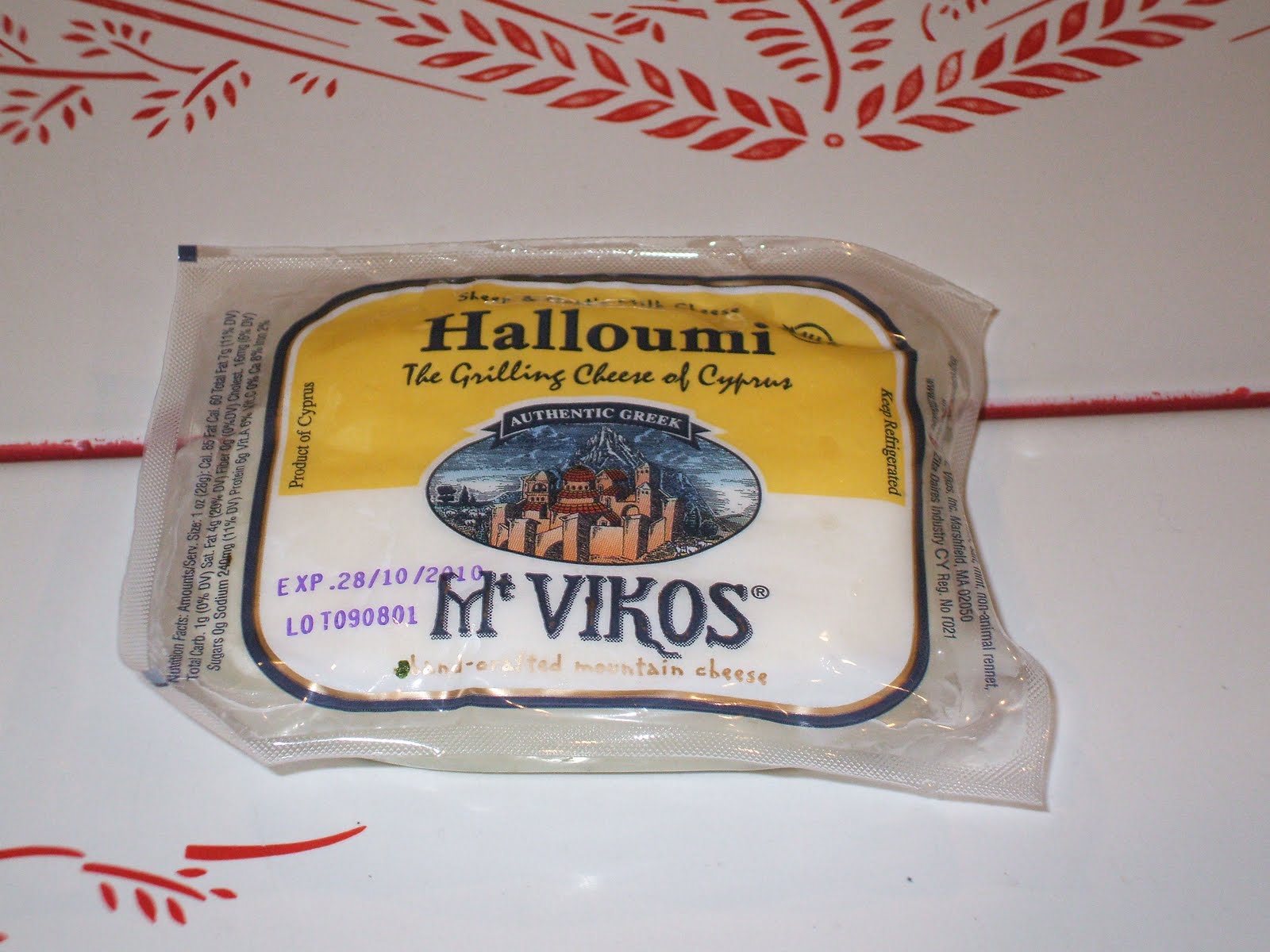
This cheese can do almost anything but melt. I usually do not advocate the freezing of cheese but http://www.cyprushalloumi.com/ states it can be "frozen for up to one year". They also suggest grating it on pasta, salads, and using it as a ravioli filling. This cheese will pair well with a minerally Sauvignon Blanc as well as a fruity Chenin Blanc, a medium bodied Pinot Grigio, and a light Edelzwicker Wines from Alsace.
When making Halloumi, the curds are cut and pressed into molds then removed from the molds and reheated in hot water or whey. The warm cheese is kneaded by hand and shaped. This is very similar to making mozzarella or pasta filata cheeses. The cheese is often sprinkled with mint but I have yet to find that it imparts any noticeable flavor. It may have been used at one time to tell how fresh the cheese was like burrata being wrapped in a leaf. If the leaf was brown the cheese was old. In these modern times, Halloumi is vacuum packed with a much longer shelf life.
Halloumi can be enjoyed the day after it is made but is often ripened for about a month. Halloumi is a salty cheese but you can make it less salty by soaking the cheese in water. I have tried two types of Halloumi, Shepherd of Cyprus 100% Sheep's milk Halloumi and Mt. Vikos Halloumi which is a blend of sheep and goat's milk. I much preferred the Shepherd of Cyprus Halloumi. It had a better texture, flavor, and browning. The Mt. Vikos was a little gritty.

Halloumi is a protected cheese which can only be made on Cyprus. They take their Halloumi very seriously and have a Halloumi police force. They make sure that Halloumi is being made within regulations and using traditional methods. There was an uproar recently when it became known that many producers were making this cheese entirely from cow's milk. The Sheep and Goat Farmer's Association is also working to remove the term Halloumi from low fat and light options that are being marketed.
Halloumi is made with sheep's milk and can be blended with goat's milk and cow's milk. As of 1985 when a law was passed, cow's milk cannot exceed the percentage of goat's milk. But there seems to be some debate regarding the interpretation of current standards for Halloumi production. Standards may not change soon as that would affect the pending application with the European Commission for a Product of Designated Origin.
Sidqui Effendi was a Turkish writer who wrote a cookbook and called Halloumi a "good food which enhances sex". I cannot see any scientific reasoning behind that comment but it is amusing. But maybe we need to conduct some studies on this matter, maybe there is a grant out there for some such study....If you conduct any research of your own, please tell us all about it by commenting below!
Tuesday, June 1, 2010
Okinawa Cheese Scene
I have just returned from two weeks in Japan, which is why I have not been posting. I spent one night in Tokyo and the rest of the time visiting family on the island of Okinawa. I was excited to explore the cheese scene in Okinawa. Whenever I travel, I like to explore local markets big and small. I visited Heiwa Dori in Naha and visited a few different Jusco store locations and a few other smaller supermarkets. I am embarrassed to say that I only just discovered Cheers!! http://www.okinawahai.com/my_weblog/2010/01/cheers-cheese-shop.html which looks like an actual cheese shop in Okinawa. I must admit I did not plan much for this trip as it was really focused on seeing family.

Visiting supermarkets, the cheese scene reminded me of what the American cheese landscape must have looked like in the 70’s. There might be a Camembert or smoked Gouda but for the most part it was processed cheese. I did find some Boursin and Mimolette in a gourmet food store. I did not see a cheese plane to go with the Mimolette as this cheese must be shaved thin or the texture is not delicious. Some of the cheese offerings were individually wrapped processed cheese squares with flavor additions like salami, black pepper, and jalapeno. They did offer Philadelphia cream cheese which is nice to see as I am a Philly girl at heart. The best cream cheese is made by Zingerman's in Ann Arbor, MI but that is hard to find outside of Michigan. All the cheeses seemed to be made from cow’s milk. I knew the island had goats so I kept searching for some goat cheese. While visiting a Jusco near Naha, I found some.

Pinza Blanc is an Okinawan goat cheese made in Nakagusuku. I used Google to translate their website http://www.hagoromo-bokujo.co.jp/ with some interesting results. The packaging seemed full of information but alas, it was all in Japanese and I have been unable to translate it into English. Goats seemed to be raised mostly for meat but this farm also makes and sells goat milk, goat yogurt, and soap in addition to the cheese.
Pinza Blanc goat cheese is hand made in a French style with a bloomy rind. The texture was slightly chalky and dry. It was more aged then brie and tasted similar to a crottin but not as yeasty. The rind was mild and did not have any bitter flavors which I often associate with brie that has aged past its prime. The Pinza Blanc did not have a strong goat flavor and was milder then Humboldt Fog. We demolished the round during a picnic and everyone, Japanese and American, really seemed to enjoy the cheese.
I was also searching for cheese in restaurants. Our first dinner out was at Kenny’s which offers Japanese, Chinese, Italian, and American cuisine. They had quite a number of cheese offerings on the menu and we tried a few of them. We enjoyed a fried cheese and potato ball which was served with fried Camembert and both were tasty. We also ordered an artful plate of cheese, ham, and avocado and a cheese plate.

The cheese plate was very dainty and consisted of a very processed cheese square which may have been cheddar, mozzarella, a standard smoked Gouda, a Camembert, and a tasty blue cheese. The plate was adorned with olives and tomatoes which were filled with cheese. Our hotel, EM Coastal Vista also offered a cheese plate but I never got to explore their rendition.
We also had a great dining experience at Cheese Cheese Cheese http://r.gnavi.co.jp/fl/en/f476301/, Okinawa’s first cheese restaurant. They did not have an English menu so my sister-in-law was nice enough to order for the group.

I am not sure what exactly we ate but we enjoyed Fondue, some roasted cheese and rice balls (onigiri which I love!), a salad with smoked Gouda and other cheeses, a cheese and potato gratin, as well as a chicken and cheese stew which was presented table side. There was a large hot stone in the pot with chicken and veggies then a rich creamy cheese sauce was poured into the bowl. We also enjoyed another dish with a table presentation but there was no cheese in this one. It was black pig that was steamed at the table and very delicious. When it comes to restaurants we visited and ambiance, this one took the cheesecake!
Japan may have the best cheese crackers I have tasted which are not 100% cheese. Cheeza crackers, http://www.glico.co.jp/cheeza/ come in 52% Cheddar cheese, 51% Camembert, and 51% Gorgonzola. I did not taste the Gorgonzola but did try the other two varieties. They are packed with real cheese flavor and have a great texture, way better than any Cheez-It. I brought home 6 packs and wish I had brought home more. I really want to try the Gorgonzola variety but did not see them until I was boarding the plane at Narita airport and I was all out of Yen.
Cheese has a place in the belly of Japan and the market seems to be growing. I watched many Japanese people enjoying tall glasses of milk during the breakfast buffet at our hotel. I have never been one to sit down to a tall glass or even a small glass of milk unless it is chocolate or accompanied by cookies. I find it strange to see an adult drinking milk with a meal but I was happily surprised by the number of people enjoying milk with their breakfast. Plus, our hotel offered a local organic milk.
One of my biggest regrets was not trying the Orange Cheese Moochi ice cream ball while I was in Tokyo. I had hoped to find one elsewhere but have had no luck. It will have to wait until my next trip along with the Gorgonzola Cheeza crackers and my visit to Cheers!!. Can't wait to tell you about everything else I ate during my trip...

Visiting supermarkets, the cheese scene reminded me of what the American cheese landscape must have looked like in the 70’s. There might be a Camembert or smoked Gouda but for the most part it was processed cheese. I did find some Boursin and Mimolette in a gourmet food store. I did not see a cheese plane to go with the Mimolette as this cheese must be shaved thin or the texture is not delicious. Some of the cheese offerings were individually wrapped processed cheese squares with flavor additions like salami, black pepper, and jalapeno. They did offer Philadelphia cream cheese which is nice to see as I am a Philly girl at heart. The best cream cheese is made by Zingerman's in Ann Arbor, MI but that is hard to find outside of Michigan. All the cheeses seemed to be made from cow’s milk. I knew the island had goats so I kept searching for some goat cheese. While visiting a Jusco near Naha, I found some.

Pinza Blanc is an Okinawan goat cheese made in Nakagusuku. I used Google to translate their website http://www.hagoromo-bokujo.co.jp/ with some interesting results. The packaging seemed full of information but alas, it was all in Japanese and I have been unable to translate it into English. Goats seemed to be raised mostly for meat but this farm also makes and sells goat milk, goat yogurt, and soap in addition to the cheese.
Pinza Blanc goat cheese is hand made in a French style with a bloomy rind. The texture was slightly chalky and dry. It was more aged then brie and tasted similar to a crottin but not as yeasty. The rind was mild and did not have any bitter flavors which I often associate with brie that has aged past its prime. The Pinza Blanc did not have a strong goat flavor and was milder then Humboldt Fog. We demolished the round during a picnic and everyone, Japanese and American, really seemed to enjoy the cheese.
I was also searching for cheese in restaurants. Our first dinner out was at Kenny’s which offers Japanese, Chinese, Italian, and American cuisine. They had quite a number of cheese offerings on the menu and we tried a few of them. We enjoyed a fried cheese and potato ball which was served with fried Camembert and both were tasty. We also ordered an artful plate of cheese, ham, and avocado and a cheese plate.

The cheese plate was very dainty and consisted of a very processed cheese square which may have been cheddar, mozzarella, a standard smoked Gouda, a Camembert, and a tasty blue cheese. The plate was adorned with olives and tomatoes which were filled with cheese. Our hotel, EM Coastal Vista also offered a cheese plate but I never got to explore their rendition.
We also had a great dining experience at Cheese Cheese Cheese http://r.gnavi.co.jp/fl/en/f476301/, Okinawa’s first cheese restaurant. They did not have an English menu so my sister-in-law was nice enough to order for the group.

I am not sure what exactly we ate but we enjoyed Fondue, some roasted cheese and rice balls (onigiri which I love!), a salad with smoked Gouda and other cheeses, a cheese and potato gratin, as well as a chicken and cheese stew which was presented table side. There was a large hot stone in the pot with chicken and veggies then a rich creamy cheese sauce was poured into the bowl. We also enjoyed another dish with a table presentation but there was no cheese in this one. It was black pig that was steamed at the table and very delicious. When it comes to restaurants we visited and ambiance, this one took the cheesecake!
Japan may have the best cheese crackers I have tasted which are not 100% cheese. Cheeza crackers, http://www.glico.co.jp/cheeza/ come in 52% Cheddar cheese, 51% Camembert, and 51% Gorgonzola. I did not taste the Gorgonzola but did try the other two varieties. They are packed with real cheese flavor and have a great texture, way better than any Cheez-It. I brought home 6 packs and wish I had brought home more. I really want to try the Gorgonzola variety but did not see them until I was boarding the plane at Narita airport and I was all out of Yen.
Cheese has a place in the belly of Japan and the market seems to be growing. I watched many Japanese people enjoying tall glasses of milk during the breakfast buffet at our hotel. I have never been one to sit down to a tall glass or even a small glass of milk unless it is chocolate or accompanied by cookies. I find it strange to see an adult drinking milk with a meal but I was happily surprised by the number of people enjoying milk with their breakfast. Plus, our hotel offered a local organic milk.
One of my biggest regrets was not trying the Orange Cheese Moochi ice cream ball while I was in Tokyo. I had hoped to find one elsewhere but have had no luck. It will have to wait until my next trip along with the Gorgonzola Cheeza crackers and my visit to Cheers!!. Can't wait to tell you about everything else I ate during my trip...
Wednesday, May 5, 2010
What it takes to coagulate
Cheese is made when milk separates into curds and whey. But how do you get a liquid to become solid? Yes, I know you can freeze a liquid to make a solid but that would not work if you are trying to make cheese. Milk can be coagulated many different ways, some of which are simple and others confusing
Milk can be coagulated by the addition of acid such as lemon juice, vinegar, or citric acid. This raises the PH of the milk and causes small, soft curds to form. Acidification can be used to make fresh cheese that included heating the curd. This is how lemon cheese, Ricotta, and paneer are made. These are very simple quick cheeses which anyone can make at home.
Time can coagulate milk and will create a product know as Bonny Clabber. Bonny Clabber is sour raw milk that is thickly curdled and comes from the Gaelic words bainne which means milk and claba which means thick. It is similar to yogurt or Quark and has a sour flavor. This is a traditional food enjoyed in the American South as well as Scotland and Ireland. But time will not produce a strong curd for making hard or aged cheeses. If you want to make cheddar you need rennet.
Rennet is a complex enzyme that occurs naturally in baby animals to aid the digestion of mother’s milk. It can be made from calves, lambs, or kids while they are only consuming milk. Calf rennet comes from the fourth stomach, which is known as the abomasums. Rennet contains chymosin and lipase as well as other enzymes. Animal rennet is 90% pure chymosin. Rennet breaks down the kappa casein protein which keeps milk in liquid form.
Animal rennet is preferred for making aged cheeses because its additional compounds can further breakdown proteins. Some people think it is cruel but I see it as using the whole animal. The animal is not killed only for its stomach. Rennet production is a natural by-product from veal production. It is also a traditional way to make cheese which I find very comforting. A cheese like Roquefort which has been made that same way for centuries could never be made with anything but animal rennet.
But let us explore the varieties of “rennet” which are being used to make cheese. This is where confusion comes into play as some of these terms are used interchangeable.
Microbial rennet is often called Vegetable rennet or Vegetarian rennet. Microbial rennet is made by fermenting fungus, bacteria, or yeast. Fungi often used are Mucor miehe, Mucor Pusillus, and Endothia cryphonectria and common bacteria are Bacillus subililis and Bacillus prodigiosum. There is no mold contained in the final product. It works as well as animal rennet but can have a bitter taste when used in cheeses that are aged over six months and does not always produce the firmest curd. Microbial rennet is suitable for vegetarians but it is not true vegetable rennet.
True vegetable rennet is made from plants such as fig tree bark, cardoon thistle, mallow, Ground Ivy, nettle and even pineapple and papaya. They can be unpredictable and bitter and there is no industrial production of vegetable rennet. If you want true vegetable rennet you must make it yourself. I have experimented with nettle and fig bark with no success. Some cheeses made cardoon thistle include Cardo from the UK, Serpa DOP from Portugal, and Caciofiore from Italy. These cheeses can range from soft and creamy to hard and aged.
The newest coagulating option is fermentation produced Chymosin Rennet also know as microbial chymosin which is made by removing the rennet producing gene from an animal cell’s DNA and then inserting it into the bacteria, mold, or yeast cell’s DNA. This will force the host to produce the chymosin enzyme which is then cultivated and fermented. It can be made cheaply and in an unlimited supply. It also does not have the bitterness often associated with microbial rennet. This is seen as a vegetarian friendly option but is derived from animals. The downside is that it is made from Genetically Modified Organisms, GMO.
In 1989, microbial chymosin was recognized by the FDA as Generally Regarded As Safe or GRAS. After a 28 month review, the FDA approved the first genetically engineered product for human consumption with the approval of microbial chymosin. It is estimated that between 70-90% of cheese produced in the United States is made with bioengineered chymosin. I personally try to avoid anything that is GMO because I do not trust its safety. But it can be hard to tell what exactly is in cheese.
The FDA does not require cheesemakers to label their cheese with the type of rennet used during production. Labels will often say “enzymes” which could include rennet made from animal, plant, microbial, or genetically engineered. They do not need to label their cheese as GMO when Fermentation produced Chymosin Rennet or microbial chymosin is used.
There are some great cheese producers in America that are happy to tell you they use vegetarian enzymes or rennet such as Cypress Grove and Cowgirl Creamery. But few seem willing to admit to the use of GMO rennet. I had no idea about GMO rennet until I researched this article. I would like to know who is using the stuff if upwards of 90% of cheeses made in the United States use microbial chymosin. Why label an item if you are going to be vague about it?
Milk can be coagulated by the addition of acid such as lemon juice, vinegar, or citric acid. This raises the PH of the milk and causes small, soft curds to form. Acidification can be used to make fresh cheese that included heating the curd. This is how lemon cheese, Ricotta, and paneer are made. These are very simple quick cheeses which anyone can make at home.
Time can coagulate milk and will create a product know as Bonny Clabber. Bonny Clabber is sour raw milk that is thickly curdled and comes from the Gaelic words bainne which means milk and claba which means thick. It is similar to yogurt or Quark and has a sour flavor. This is a traditional food enjoyed in the American South as well as Scotland and Ireland. But time will not produce a strong curd for making hard or aged cheeses. If you want to make cheddar you need rennet.
Rennet is a complex enzyme that occurs naturally in baby animals to aid the digestion of mother’s milk. It can be made from calves, lambs, or kids while they are only consuming milk. Calf rennet comes from the fourth stomach, which is known as the abomasums. Rennet contains chymosin and lipase as well as other enzymes. Animal rennet is 90% pure chymosin. Rennet breaks down the kappa casein protein which keeps milk in liquid form.
Animal rennet is preferred for making aged cheeses because its additional compounds can further breakdown proteins. Some people think it is cruel but I see it as using the whole animal. The animal is not killed only for its stomach. Rennet production is a natural by-product from veal production. It is also a traditional way to make cheese which I find very comforting. A cheese like Roquefort which has been made that same way for centuries could never be made with anything but animal rennet.
But let us explore the varieties of “rennet” which are being used to make cheese. This is where confusion comes into play as some of these terms are used interchangeable.
Microbial rennet is often called Vegetable rennet or Vegetarian rennet. Microbial rennet is made by fermenting fungus, bacteria, or yeast. Fungi often used are Mucor miehe, Mucor Pusillus, and Endothia cryphonectria and common bacteria are Bacillus subililis and Bacillus prodigiosum. There is no mold contained in the final product. It works as well as animal rennet but can have a bitter taste when used in cheeses that are aged over six months and does not always produce the firmest curd. Microbial rennet is suitable for vegetarians but it is not true vegetable rennet.
True vegetable rennet is made from plants such as fig tree bark, cardoon thistle, mallow, Ground Ivy, nettle and even pineapple and papaya. They can be unpredictable and bitter and there is no industrial production of vegetable rennet. If you want true vegetable rennet you must make it yourself. I have experimented with nettle and fig bark with no success. Some cheeses made cardoon thistle include Cardo from the UK, Serpa DOP from Portugal, and Caciofiore from Italy. These cheeses can range from soft and creamy to hard and aged.
The newest coagulating option is fermentation produced Chymosin Rennet also know as microbial chymosin which is made by removing the rennet producing gene from an animal cell’s DNA and then inserting it into the bacteria, mold, or yeast cell’s DNA. This will force the host to produce the chymosin enzyme which is then cultivated and fermented. It can be made cheaply and in an unlimited supply. It also does not have the bitterness often associated with microbial rennet. This is seen as a vegetarian friendly option but is derived from animals. The downside is that it is made from Genetically Modified Organisms, GMO.
In 1989, microbial chymosin was recognized by the FDA as Generally Regarded As Safe or GRAS. After a 28 month review, the FDA approved the first genetically engineered product for human consumption with the approval of microbial chymosin. It is estimated that between 70-90% of cheese produced in the United States is made with bioengineered chymosin. I personally try to avoid anything that is GMO because I do not trust its safety. But it can be hard to tell what exactly is in cheese.
The FDA does not require cheesemakers to label their cheese with the type of rennet used during production. Labels will often say “enzymes” which could include rennet made from animal, plant, microbial, or genetically engineered. They do not need to label their cheese as GMO when Fermentation produced Chymosin Rennet or microbial chymosin is used.
There are some great cheese producers in America that are happy to tell you they use vegetarian enzymes or rennet such as Cypress Grove and Cowgirl Creamery. But few seem willing to admit to the use of GMO rennet. I had no idea about GMO rennet until I researched this article. I would like to know who is using the stuff if upwards of 90% of cheeses made in the United States use microbial chymosin. Why label an item if you are going to be vague about it?
Sunday, April 18, 2010
Cheese Demonstration!
Yesterday, I hosted the first of what I hope to be many cheese demonstrations. As an active member in Slow Food DC, the event was open to 15 Slow Food DC members. My kitchen was just big enough to accommodate 15 people plus my husband and me. We started the event with a milk tasting. I get my raw cow's milk from a farm in Catlett and I pick up my raw goat's milk in Nokesville. Many people were surprised by the sweetness of the goat's milk. The cow and the goat's milk were both very fresh as the animals had been milked only two days before the event.
We talked cheese and everyone was really great at asking questions. It is always fun to interact with new people and I love talking cheese. We then moved into making 30 minute mozzarella. I used a gallon of raw cow's milk to make the cheese and added citric acid and rennet. The milk is so good and fresh that I forms a curd easily. I pulled and stretched the 110 degree curd by hand which is hot hot work. A few attendees tried their hand at pulling the curd. I couldn't seem to decide if I wanted to make a ball, small balls, or a braid. It may not have been the prettiest mozzarella but it was tasty. I did not add any salt but will in the future.
Then we tasted some cheese! We sampled some of my chevre which was made 5 days prior to the event. The next cheese was a commercially available chevre from a producer in Maryland. Many were surprised by how mild and creamy my cheese was especially when compared to the goatier commercial chevre. It all comes down to the freshness as chevre will become goatier as it ages. Then we sampled Gervais, a fresh French cow's milk cheese that is enriched with cream. This cheese had a wonderful butter yellow color which comes from the beta carotene in the grass fed cow's milk. Next we tasted Bondon which is very similar to Gervais but without the added cream. We moved into our flavored cheeses with Porcini Bondon and Rosemary Feta. I had been unhappy with my last two batches of Rosemary Feta but everyone at the event really loved this cheese just the way it was. The last cheese we tasted was Gjetost which I made from boiling goat's whey for about 12 hours and added cow's cream around hour 6. This cheese surprised a lot of people with its sweet savory flavor combinations.
It was so valuable for me to get feedback on my cheeses from a room full of strangers. Sometimes I think my husband and friends are just saying they like my cheese because they like me. At the end of the event, people wanted cheese and I had some to give them. I collected some donations and people were very generous. The event was fun and mutually beneficial. I hope to host another one in June and all proceeds will go toward opening my cheese making facility.
This is the recommend reading list from the cheese event. These books really helped me learn about cheese and how to make cheese. I must also mention culture magazine which you can follow on Facebook and Cheese Enthusiast, another great publication.
The Atlas of American Cheese by Jeffrey P. Roberts ISBN 978-1-933392-34-9 This book lists cheese producers by state and includes information on touring cheesemakers.
Home Cheese Making by Ricki Carroll ISBN 978-1-58017-464-0 This book has many wonderful recipes including the 30 minute mozzarella recipe. I also get most of my cheesemaking supplies from her website http://www.cheesemaking.com/
Making Artisan Cheese by Tim Smith ISBN 978-1-59253-197-4 This book has 50 great recipes.
The Cheese Chronicles by Liz Thorpe ISBN 978-0-06-145116-4 This book is such a fun read and you learn a lot about American cheesemakers.
Cheese & Wine by Janet Fletcher ISBN 978-0-8118-5743-7 This book in beautiful and informative.
Cheese by Max McCalaman & David Gibbons ISBN 1-4000-5034-0 Another cheese porn book full of pretty pictures and great information.
The Cheese Lover's Companion by Sharon Tyler Herbst and Ron Herbst ISBN 978-0-06-053704-3 This is a cheese dictionary and covers a variety of cheese related terms.
Fundamentals of Cheese Science which is an Aspen Publication and 4 co-authors which is why I am not listing them all ISBN 0-8342-1260-9 This is my hardcore cheese textbook.
If you would like to host a Cheese Demonstration! at my place or yours, send an email to cheese4charlotte@yahoo.com or post a message below. The demo runs about 2 hours with an additional hour and a half for set up and includes making mozzarella, milk tasting, cheese tasting, and a cheese discussion with Q&A. The total cost for the event is $100 for a group of up to 15 people and covers the cost of all cheese making ingredients, equipment, and time. Travel may be additional depending on location.
We talked cheese and everyone was really great at asking questions. It is always fun to interact with new people and I love talking cheese. We then moved into making 30 minute mozzarella. I used a gallon of raw cow's milk to make the cheese and added citric acid and rennet. The milk is so good and fresh that I forms a curd easily. I pulled and stretched the 110 degree curd by hand which is hot hot work. A few attendees tried their hand at pulling the curd. I couldn't seem to decide if I wanted to make a ball, small balls, or a braid. It may not have been the prettiest mozzarella but it was tasty. I did not add any salt but will in the future.
Then we tasted some cheese! We sampled some of my chevre which was made 5 days prior to the event. The next cheese was a commercially available chevre from a producer in Maryland. Many were surprised by how mild and creamy my cheese was especially when compared to the goatier commercial chevre. It all comes down to the freshness as chevre will become goatier as it ages. Then we sampled Gervais, a fresh French cow's milk cheese that is enriched with cream. This cheese had a wonderful butter yellow color which comes from the beta carotene in the grass fed cow's milk. Next we tasted Bondon which is very similar to Gervais but without the added cream. We moved into our flavored cheeses with Porcini Bondon and Rosemary Feta. I had been unhappy with my last two batches of Rosemary Feta but everyone at the event really loved this cheese just the way it was. The last cheese we tasted was Gjetost which I made from boiling goat's whey for about 12 hours and added cow's cream around hour 6. This cheese surprised a lot of people with its sweet savory flavor combinations.
It was so valuable for me to get feedback on my cheeses from a room full of strangers. Sometimes I think my husband and friends are just saying they like my cheese because they like me. At the end of the event, people wanted cheese and I had some to give them. I collected some donations and people were very generous. The event was fun and mutually beneficial. I hope to host another one in June and all proceeds will go toward opening my cheese making facility.
This is the recommend reading list from the cheese event. These books really helped me learn about cheese and how to make cheese. I must also mention culture magazine which you can follow on Facebook and Cheese Enthusiast, another great publication.
The Atlas of American Cheese by Jeffrey P. Roberts ISBN 978-1-933392-34-9 This book lists cheese producers by state and includes information on touring cheesemakers.
Home Cheese Making by Ricki Carroll ISBN 978-1-58017-464-0 This book has many wonderful recipes including the 30 minute mozzarella recipe. I also get most of my cheesemaking supplies from her website http://www.cheesemaking.com/
Making Artisan Cheese by Tim Smith ISBN 978-1-59253-197-4 This book has 50 great recipes.
The Cheese Chronicles by Liz Thorpe ISBN 978-0-06-145116-4 This book is such a fun read and you learn a lot about American cheesemakers.
Cheese & Wine by Janet Fletcher ISBN 978-0-8118-5743-7 This book in beautiful and informative.
Cheese by Max McCalaman & David Gibbons ISBN 1-4000-5034-0 Another cheese porn book full of pretty pictures and great information.
The Cheese Lover's Companion by Sharon Tyler Herbst and Ron Herbst ISBN 978-0-06-053704-3 This is a cheese dictionary and covers a variety of cheese related terms.
Fundamentals of Cheese Science which is an Aspen Publication and 4 co-authors which is why I am not listing them all ISBN 0-8342-1260-9 This is my hardcore cheese textbook.
If you would like to host a Cheese Demonstration! at my place or yours, send an email to cheese4charlotte@yahoo.com or post a message below. The demo runs about 2 hours with an additional hour and a half for set up and includes making mozzarella, milk tasting, cheese tasting, and a cheese discussion with Q&A. The total cost for the event is $100 for a group of up to 15 people and covers the cost of all cheese making ingredients, equipment, and time. Travel may be additional depending on location.
Sunday, March 14, 2010
I've got the blues!
Early last week, I thought Spring had arrived despite the occasional pile of snow here and there. The sun was bright, the weather warm, and I could leave the house in just a short sleeve shirt. But it was too good to last and the sunshine has been replaced with rain. I am thankful that it is not snow but I am tired of gray weather. As The Carpenters said "Rainy days and Mondays always get me down". The lack of sun and vitamin D has forced me to seek comfort in cheese. But not just any cheese, I find myself craving blue cheese more and more on these rainy gray days.
Blue cheese is a family or type of cheese, not a specific cheese. When I see a container of blue cheese crumbles, I have to wonder what kind of blue cheese is actually in there or did they just let some other cheese get moldy. There are many different types of blue cheeses. Some are made from cow's milk, sheep's milk, a combination of milks, and the use of goat's milk is becoming more popular. There are blue cheeses with natural rinds, foil wrapped blues without rinds, and blue cheese with bloomy rinds. There is even one blue cheese with a black wax rind called Roaring 40's from King Island Dairy is Australia. There are soft creamy blues, crumbly blues, and drier styles of blue cheese. Some blues are mild like Regina and really abrasive blues like Tilston Point. There is even a blue cheese that is cold smoked over hazelnut shells, Smokey Blue which is made by the blue cheese masters at Rouge Creamery in Oregon.

This is an up close look at Verde Capra which is an Italian goat's milk blue
There are a couple of different ways to make blue cheese, the first few steps are the same as any other cheese making process. The big difference is the addition of a mold culture. You can add the mold to the milk when making the cheese or you can spray on the mold after the wheel of cheese is made. Either way, the cheese must be pierced to create air channels to promote the growth of the mold. Air is necessary for the creation of mold because mold is alive. Sometimes these air channels are made by piercing the cheese with wheat stalks but more often stainless steal needles are used. When a wheel of blue is cut into for the first time, the green streaks of mold become more blue due to the exposure of air. I love to watch this magic happen.
One of the most famous styles of blue cheese is Roquefort which is made from raw sheep's milk. When you eat Roquefort, you are eating history. This cheese has been made using the same methods, same molds, and aged in the same location for centuries. No one is exactly sure how Roquefort was first made but there has been speculation. A shepherd sits down at the mouth of a cave to enjoy his lunch of bread and cheese when a beautiful woman saunters by and distracts him from his lunch. They run off to romp and by the time the shepherd returns, his bread is moldy and that mold has infected his cheese. This does not deter the man from enjoying his cheese and he finds the taste of the cheese to be improved by the mold.
The enjoyment of blue cheese is very much like wine appreciation, you have to develop your palette. The more blue cheese you eat, the more you will enjoy this moldy cheese and the more adventurous your tastes will become. If you are not a fan of blue cheese or find them intimidating, try a milder sweeter blue like Gorgonzola Dolce. Another way to enhance your blue cheese palette is to pair the cheese with the right beverage or food. Blue cheese will pair well with sweeter wines and ports. Port and Stilton is a classic wine and cheese combination. Blue cheese is great melted on a steak or burger and makes a wonderful addition to sauces and salad dressings. Try a bit of blue cheese with a sweeter bread like raisin walnut bread or Raincoast Crisps. You can also drizzle your blue in honey or Saba or with pears and walnuts.
Blue cheese is a family or type of cheese, not a specific cheese. When I see a container of blue cheese crumbles, I have to wonder what kind of blue cheese is actually in there or did they just let some other cheese get moldy. There are many different types of blue cheeses. Some are made from cow's milk, sheep's milk, a combination of milks, and the use of goat's milk is becoming more popular. There are blue cheeses with natural rinds, foil wrapped blues without rinds, and blue cheese with bloomy rinds. There is even one blue cheese with a black wax rind called Roaring 40's from King Island Dairy is Australia. There are soft creamy blues, crumbly blues, and drier styles of blue cheese. Some blues are mild like Regina and really abrasive blues like Tilston Point. There is even a blue cheese that is cold smoked over hazelnut shells, Smokey Blue which is made by the blue cheese masters at Rouge Creamery in Oregon.

This is an up close look at Verde Capra which is an Italian goat's milk blue
There are a couple of different ways to make blue cheese, the first few steps are the same as any other cheese making process. The big difference is the addition of a mold culture. You can add the mold to the milk when making the cheese or you can spray on the mold after the wheel of cheese is made. Either way, the cheese must be pierced to create air channels to promote the growth of the mold. Air is necessary for the creation of mold because mold is alive. Sometimes these air channels are made by piercing the cheese with wheat stalks but more often stainless steal needles are used. When a wheel of blue is cut into for the first time, the green streaks of mold become more blue due to the exposure of air. I love to watch this magic happen.
One of the most famous styles of blue cheese is Roquefort which is made from raw sheep's milk. When you eat Roquefort, you are eating history. This cheese has been made using the same methods, same molds, and aged in the same location for centuries. No one is exactly sure how Roquefort was first made but there has been speculation. A shepherd sits down at the mouth of a cave to enjoy his lunch of bread and cheese when a beautiful woman saunters by and distracts him from his lunch. They run off to romp and by the time the shepherd returns, his bread is moldy and that mold has infected his cheese. This does not deter the man from enjoying his cheese and he finds the taste of the cheese to be improved by the mold.
The enjoyment of blue cheese is very much like wine appreciation, you have to develop your palette. The more blue cheese you eat, the more you will enjoy this moldy cheese and the more adventurous your tastes will become. If you are not a fan of blue cheese or find them intimidating, try a milder sweeter blue like Gorgonzola Dolce. Another way to enhance your blue cheese palette is to pair the cheese with the right beverage or food. Blue cheese will pair well with sweeter wines and ports. Port and Stilton is a classic wine and cheese combination. Blue cheese is great melted on a steak or burger and makes a wonderful addition to sauces and salad dressings. Try a bit of blue cheese with a sweeter bread like raisin walnut bread or Raincoast Crisps. You can also drizzle your blue in honey or Saba or with pears and walnuts.
Friday, March 12, 2010
From Whey to Cheese!
Earlier this week I made some Feta cheese with farm fresh goat’s milk. When you make cheese, the milk breaks into two parts, curds (cheese) and liquid whey. Whey can be great for the garden and is often feed to pigs. Seeing as I don’t have any pigs, I have given it to my dogs and my Pomeranian loves it while my Chinese Crested hairless throws it up as his digestive system is very delicate.
Every time I make cheese, I also make whey and hate to waste it. I like the idea that one gallon of milk can produce two different products. Whey is ready for consumption and was commonly enjoyed in coffeehouses and inns in the 18th century. You can add some lemon and sugar to make whey lemonade. Today whey is often sold as a nutritional supplement in the form of a dried powder.
Whey can also be called milk plasma which sounds a little gross. Whey contains proteins, vitamins, minerals, lactose, and a trace amount of fat. Studies have shown that whey can stimulate insulin production and can assist in regulating and reducing spikes in blood sugar. The protein in whey is more easily absorbed then the proteins in egg whites which is apart of the body building appeal. Whey can also prevent the atrophy of muscular cells which is another attraction.
After making the Feta, I decided to experiment with the whey. Whey can be made into cream, butter, Ricotta, Brunost, Gjetost, and Mytost. These last 3 cheeses are very similar and names can vary by regions. Brunost is Norwegian for brown cheese and Gjetost and Mytost are types of brown cheese. Gjetost is a goat’s milk version and Mytost is made from cow’s milk. I found a recipe for Mytost that included substitutions to make Gjetost. Gjetost is pronounce like "yay toast" which I think is a very fun cheese name!
One issue with making cheese from whey is the short window of time. The whey cannot be more that 4 hours old for the production of Ricotta or Brunost. I had finished making my Feta around 6 p.m. and began to boil down the whey. The recipe said that foam would rise to the top and to skim it off and reserve it for later but this did not occur in my pot. Adding the foam back was supposed to help thicken the whey. Once the whey starts to thicken, I poured it into a blender and blended for about a minute. This is supposed to make a smoother cheese but it also made it foam and thicken.
The recipe also had an option to add cream to the mix but seeing as I didn’t have any I left that step out. Boiling down the whey can take 6-12 hours and by 11 p.m. I was a very sleepy girl who did not want to leave the whey unattended on the stove. The whey had drastically decreased in volume so I hoped I was getting close to cheese. At first the whey was a thin liquid with a cream colored tinge, as the whey boiled down and I stirred the liquid, I could feel it thickening.
I spent an hour stirring my hot pot with the intention to give up at midnight. At about 11:45 p.m., the whey began to turn into the consistency of caramel sauce. Time will produce more caramelization and the color would become a deeper shade of brown and the flavors more concentrated. At midnight, I placed my pot in a cold bath and stirred some more until the thick cheese sauce had cooled. I then poured it into a buttered tupperwear and put it into the fridge where it will keep for up to four weeks.
As my time management skills were lacking, my cheese was a tan color. I know step by step photos of this process would be nice but I did not take any, sorry. But here is the finished product.


My Gjetost was softer and creamier then store bought versions which tend to be semi-firm. The texture of my Gjetost was similar to fudge but it did have some sandy grains despite the blending but maybe I should have blended it longer. I think it tasted just like the innards of a Lance’s sour cream & chive wheat cracker but without the chive. It was sweet and tangy with notes of caramel and salt. Next time, I will start my cheesemaking process earlier and let my whey go longer.
Every time I make cheese, I also make whey and hate to waste it. I like the idea that one gallon of milk can produce two different products. Whey is ready for consumption and was commonly enjoyed in coffeehouses and inns in the 18th century. You can add some lemon and sugar to make whey lemonade. Today whey is often sold as a nutritional supplement in the form of a dried powder.
Whey can also be called milk plasma which sounds a little gross. Whey contains proteins, vitamins, minerals, lactose, and a trace amount of fat. Studies have shown that whey can stimulate insulin production and can assist in regulating and reducing spikes in blood sugar. The protein in whey is more easily absorbed then the proteins in egg whites which is apart of the body building appeal. Whey can also prevent the atrophy of muscular cells which is another attraction.
After making the Feta, I decided to experiment with the whey. Whey can be made into cream, butter, Ricotta, Brunost, Gjetost, and Mytost. These last 3 cheeses are very similar and names can vary by regions. Brunost is Norwegian for brown cheese and Gjetost and Mytost are types of brown cheese. Gjetost is a goat’s milk version and Mytost is made from cow’s milk. I found a recipe for Mytost that included substitutions to make Gjetost. Gjetost is pronounce like "yay toast" which I think is a very fun cheese name!
One issue with making cheese from whey is the short window of time. The whey cannot be more that 4 hours old for the production of Ricotta or Brunost. I had finished making my Feta around 6 p.m. and began to boil down the whey. The recipe said that foam would rise to the top and to skim it off and reserve it for later but this did not occur in my pot. Adding the foam back was supposed to help thicken the whey. Once the whey starts to thicken, I poured it into a blender and blended for about a minute. This is supposed to make a smoother cheese but it also made it foam and thicken.
The recipe also had an option to add cream to the mix but seeing as I didn’t have any I left that step out. Boiling down the whey can take 6-12 hours and by 11 p.m. I was a very sleepy girl who did not want to leave the whey unattended on the stove. The whey had drastically decreased in volume so I hoped I was getting close to cheese. At first the whey was a thin liquid with a cream colored tinge, as the whey boiled down and I stirred the liquid, I could feel it thickening.
I spent an hour stirring my hot pot with the intention to give up at midnight. At about 11:45 p.m., the whey began to turn into the consistency of caramel sauce. Time will produce more caramelization and the color would become a deeper shade of brown and the flavors more concentrated. At midnight, I placed my pot in a cold bath and stirred some more until the thick cheese sauce had cooled. I then poured it into a buttered tupperwear and put it into the fridge where it will keep for up to four weeks.
As my time management skills were lacking, my cheese was a tan color. I know step by step photos of this process would be nice but I did not take any, sorry. But here is the finished product.


My Gjetost was softer and creamier then store bought versions which tend to be semi-firm. The texture of my Gjetost was similar to fudge but it did have some sandy grains despite the blending but maybe I should have blended it longer. I think it tasted just like the innards of a Lance’s sour cream & chive wheat cracker but without the chive. It was sweet and tangy with notes of caramel and salt. Next time, I will start my cheesemaking process earlier and let my whey go longer.
Subscribe to:
Posts (Atom)