I take cheese for granted, I always expect to find a large cheese selection from all over the world and not just from cow's milk wherever I go out food shopping. I grew up in a family where Pate, cornishons, and Chevre were present at every family gathering. I lived in a large city, Philadelphia, that had a number of cheese shops where even some of the small corner delis carried excellent cheese. I cannot imagine a time where cheese was limited, bland, and boring. But that time was not too long ago and the market for cheese in America was very limited. People wanted Colby not Brie, Cheddar not Chevre, Velvetta not Pecorino.
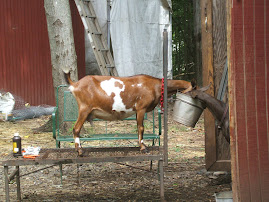
One of the women at the forefront of the American cheese revolution was Mary Keehn. She was a mother looking for a milk substitute for her children who had difficulty digesting cow's milk. Many people have issues with cow's milk and find goat milk to be a wonderful alternative. So Mary got a few goats and soon became a premiere goat breeder. With 50 goats she soon found that she had way too much milk and needed an outlet for the surplus. In 1983, I was a mere three years old, she started Cypress Grove.
It took a number of years before her cheese was accepted in the United States. She used the time to learn about cheese, care for her goats, land, and her small clientele. Speaking no French, she traveled to France and fell in love with the soft cheeses of France. She learned to make bloomy-rinded cheeses despite the language barrier.
In 2003 she sold off her goats to focus on making and selling cheese. The market for cheese in America had grown exponentially and Mary's cheeses were extremely popular. Cypress Grove makes many award winning cheeses such as Humboldt Fog, Purple Haze, Lamb Chopper, and Midnight Moon. Midnight Moon is one of my favorite all time cheeses, I love its flavor and texture.
Whenever someone comes up to my cheese counter and admits that they do not like goat cheese, I give them a taste of Midnight Moon. I often don't tell them it is a goat cheese until after they taste. So far, everyone has liked it and no one has yet to be upset that I forced them to eat goat cheese. When people hear goat cheese they think of a fresh tangy chevre but that is just one style of goat cheese. Midnight Moon is nothing like chevre, it is more akin to a Dutch Gouda and for very good reasons.
Cypress Grove started a production line in Holland, Cypress Crove Creamline. In 1992 they began producing Midnight Moon and Lambchopper. This was a time when Cypress Grove was outgrowing its Californian cheese making plant but was unable to financially expand beyond making fresh cheese. Cypress Grove Creamline was able to increase profits and offer great cheeses with a smaller financial investment.
Midnight Moon and Lambchopper are made following a Dutch Gouda recipe. This cheese was conceived in California and produced in Holland. Midnight Moon is encased in wax and develops a sweetness as it ages. This cheese is aged for a minimum of six months and during this time, the magic happens. This time allows the cheese to develop a sweetness but also pockets of salty crunch that are actually concentrated proteins. I love a cheese with a salty crystalline crunch. Midnight Moon has notes of caramel, brown butter, and nuts with a dense and creamy texture.
This cheese is wonderful on its own or served with walnut raisin bread or melted in an omelet. This cheese will pair well with many styles of wine such as Rose, Sauvignon Blanc, Pinot Grigio, Syrah, Pinot Noir, Chardonnay, Cabernet Franc, Dry Sherry, Gewürztraminer, Zinfandel, and Cabernet Sauvignon.
Showing posts with label goat cheese. Show all posts
Showing posts with label goat cheese. Show all posts
Monday, February 15, 2010


Wednesday, February 3, 2010
Garrotxa
Garrotxa is a goat’s milk cheese from Spain which is made in the northern region of Catalonia in Girona. This region is unpolluted, mountainous, and rainy. The high rainfall provides rich lush grasses for grazing goats which makes for excellent milk.
Many believe Garrotxa is a new cheese but it is actually a lost cheese. After the Spanish Civil War and World War II, Spain was struggling with poverty. The Spanish government implemented a policy that basically outlawed small scale farming and production. Limits were placed on milk production forcing dairies to produce large quantities or cease production. This forced many small scale cheese producers underground and some cheese disappeared completely. In the 1990’s, the traditional recipe for Garrotxa was found and Garrotxa was resurrected.
Garrotxa is made using traditional methods with a modern twist. This cheese is aged for 4 months during which time it develops its natural rind which has a velvety texture and blue grey color. These small wheels of cheese are compact and semi-soft. The paste is snow white, smooth, creamy, and slightly flaky. The taste has notes of hazelnuts, lemon, and herbs. This cheese melts on the tongue and has a smooth finish. This cheese pairs well with sparkling wines, Albarino, Tempranillo, Grenache, Sauvignon Blanc, and Chardonnay.
Subscribe to:
Posts (Atom)